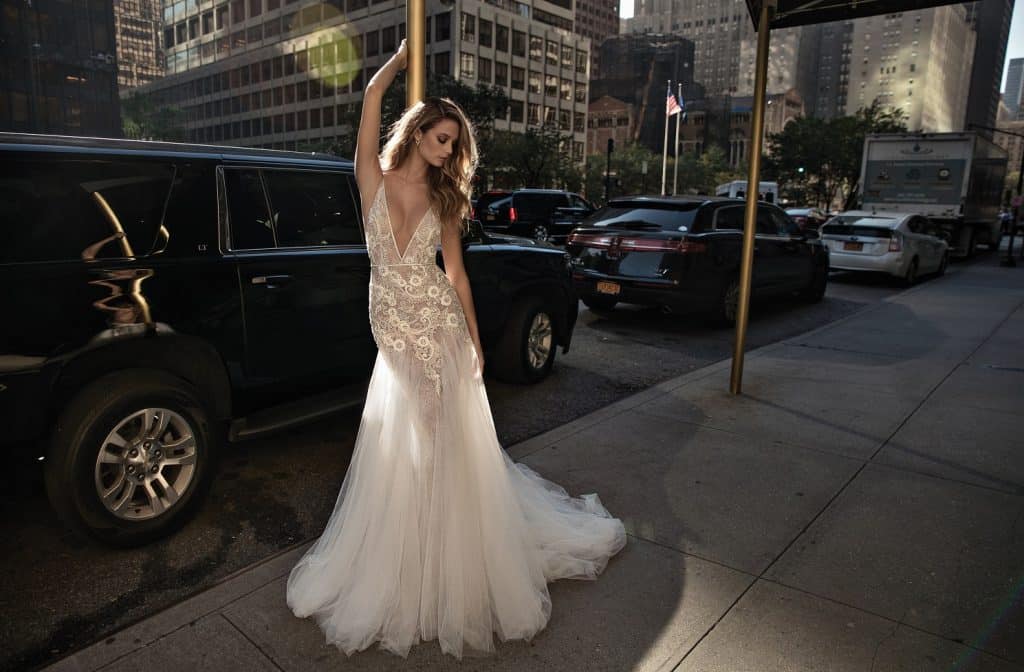
Almost no fashion brand becomes synonymous with an entire design aesthetic. In bridal, BERTA did.
Berta Balilti founded her fashion house in 2004 in Ashdod, an industrial port city 20 miles south of Tel Aviv that ranks medium low on Israel’s socioeconomic scale and sits nowhere near the country’s fashion scene. Two decades on, the label sells through more than 150 retailers worldwide, keeps a flagship showroom in SoHo, and counts over three million followers across social media, 2.6 million of them on Instagram.
The New York Times has credited BERTA as one of the designers who caused a shift in the bridal fashion world toward a bolder, sexier style. ELLE and VOGUE have both counted Balilti among the leading bridal and eveningwear designers working today.
Couture level of quality, in retail prices that are closer to those of mass production brands.
BERTA, on its own positioning
 A new
A newperspective
on bridal
The beginning
A studio that started in Ashdod
Balilti studied in the fashion design department at Shenkar College of Engineering and Design in Tel Aviv, and founded the house that carries her name in 2004. She is still its only designer, and she oversees production in the studio herself.
The house is headquartered in Ashdod, a city of roughly 230,000 built around the largest port in Israel, which handles about 60 percent of the country’s cargo. Close to a third of its residents are immigrants, most of them from the former Soviet Union. It is an industrial working town rather than a design address, and the brand stayed there as it grew: the gowns that go out to boutiques in New York, London and Sydney are still designed and supervised from the same place they started.
 Haute couture
spirit
One designer, one studio
That structure matters more than it sounds. In a house this size, design is usually handled by a team that changes over the years, which is also why a label can drift away from the look it became known for. A single designer, in one studio, across two decades, is the simplest explanation for why a BERTA gown from 2012 and one from 2026 still read as the same house.
The first years, in a conservative market
In the early 2000s the Israeli bridal market was built on classic, largely covered lines. The house went the other way from the start, with fitted silhouettes, built in corsetry and heavy handwork, and that was not the safe commercial choice at the time.
A distinctive design language
Bold, sexy, modern
Those three words are the house’s own description of its aesthetic, and the brand pairs them with an avant garde sensibility and a habit of pulling vintage materials and retro styles into contemporary cuts.
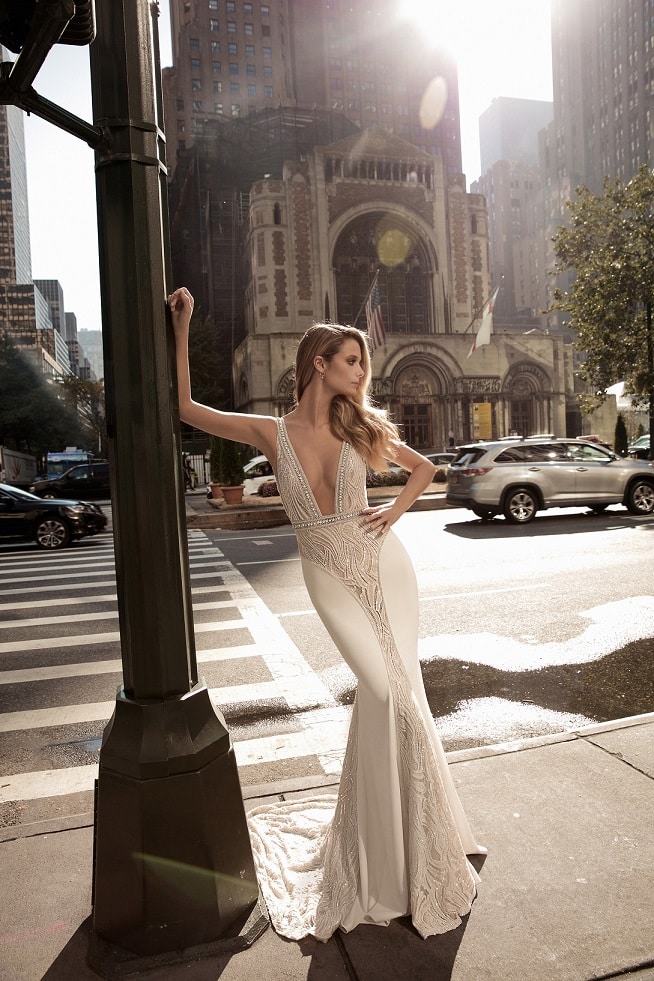
In the gowns themselves the language shows up as a set of elements that keep returning: figure hugging silhouettes, deep necklines, nude illusion details, delicate lace, sheer paneling and high slits.
 Structure
first
Structure comes first
The part of a BERTA gown that does the most work is the part nobody sees. Corsetry is built into the dress, so the waistline and the line of the body are set by internal construction rather than by the fabric on top of it.
This is standard couture practice, and it is also why a heavily structured gown can look like a different object on a hanger than it does on a body. The shape is engineered, and it only resolves once someone is inside it.
Handwork, applied one piece at a time
Lace, beading and embroidery on these gowns are applied by hand. That is the slow part of couture production, and it is the reason two gowns cut from the same pattern are never quite identical.
Placement is the skill, not the quantity. Embellishment that follows the seams and the lines of the body reinforces the structure underneath it, while the same amount spread evenly over a gown flattens it.
Illusion, in measured doses
Sheer panels and nude illusion are among the elements most associated with the house. Used sparingly they create depth and let a neckline or a back open up without losing the structure; used everywhere they become the whole dress. The difference between the two is dosage, and it is one of the harder things to get right in bridal.
Built to move
A wedding gown does not live on a mannequin. It walks, turns, sits through a dinner, dances and gets photographed from every angle for twelve hours. Layers of tulle, a long train and lightweight fabrics behave very differently in a fitting room than they do halfway through an evening, and a gown engineered around internal structure keeps its line while the outer layers move.
That is also the quality that makes these gowns work in editorial photography, where movement is usually the whole shot.

From Israel to the world
The years the brand went global
The house entered the international scene in 2013, nine years after it opened. New York runway presentations followed and became the brand’s regular stage.
The Fall/Winter 2016 collection was presented at The Plaza Hotel in October 2015. Spring/Summer 2017 followed at the Harvard Club of New York in April 2016, and Fall/Winter 2020 at the World Trade Center in October 2019.
 On location
New York
Where the gowns actually sell
The brand is carried by more than 150 retailers worldwide and runs its own flagship showroom in SoHo, Manhattan. Coverage followed the distribution: the house has appeared in Vogue and Vogue Arabia, BRIDES, The Knot Worldwide, Style Me Pretty and Wedding Chicks.
Bridal is one of the few corners of fashion where a label can build an international business without sitting inside a fashion capital, because the buying runs through specialist boutiques rather than department stores. BERTA is one of the clearest examples of that route.
The Israeli bridal wave
BERTA is not an isolated case. Over the last two decades Israel has become one of the countries most closely identified with luxury bridal and eveningwear, with houses including Galia Lahav, Pnina Tornai and Lee Grebenau building their own international businesses and their own recognizable design languages.
Israel is not a force in streetwear or in mass market fashion. In bridal and eveningwear it is, and the reasons are structural: a tradition of high end tailoring, ateliers small enough to do genuine handwork and real customization, and brands that aimed at an international audience from the beginning because the local market alone was never large enough to support them.
Signature collections
One house, several lines
Rather than reshape the main label every few seasons, the house opened additional lines. Each one speaks to a different bride and keeps the same design DNA.
The flagship BERTA line is the one most people picture when they hear the name, and it is where the most elaborate handwork and the most structured corsetry sit.
 One house,
one language
MUSE by BERTA
A lighter reading of the same language, described in its collections as modern yet romantic: illusion panels, deep necklines, sheer paneling and high slits, in silhouettes that carry less weight than the couture line.

BERTA PRIVÉE
Figure hugging silhouettes with delicate lace, nude illusion details, vintage fabrics and retro styles. The line runs in numbered collections rather than seasons.
BERTA EVENING, and Jolie
Eveningwear is a line of its own, which is part of why the name turns up on red carpets and not only at weddings. A further line, Jolie, launched in 2020.
Why brides choose BERTA
Recognition, and the red carpet
Gowns from the house have been worn by Britney Spears, Priyanka Chopra, Sharon Stone, Carrie Underwood, Kylie Jenner, Kourtney Kardashian, Ariana Grande and Sofia Vergara.
More than three million social followers, 2.6 million of them on Instagram, put these gowns in front of brides long before anyone books an appointment. Detailed embellishment and a clear silhouette photograph well, which is exactly what travels on a feed.
 Seen
Seeneverywhere
Visibility, then the fitting
Visibility explains the awareness. It does not explain a twenty year business, which rests on production quality, an international retailer network and long relationships with the boutiques that specialize in luxury bridal.
How the house positions itself
The brand’s own claim is couture level quality at retail prices closer to those of mass production brands. Whatever a given gown costs, the positioning is the point: couture technique offered as a product with real distribution behind it, rather than as one off commissions.

What comes next
An Israeli house on the global map
Two decades in, BERTA is one of the Israeli houses that turned the country into a reference point for luxury bridal design, and the bolder, body conscious look the New York Times credited it with pushing is now standard at the high end of the market.
Any house can produce one collection that lands. Staying recognizable across twenty years of collections, in a category that turns over constantly, is the harder thing, and it is the thing this house has actually built.
 Two decades
in
The test is time, not a single collection
Collections keep coming across every line, the silhouettes move with the market, and the design language underneath them has not been traded away for a trend.
Bridal has moved toward minimalism in recent seasons, and the interesting question for any established house is what it does with a shift like that. The evolutionary answer, which is the one this house has taken, is to let cleaner elements into a design language that already exists rather than to replace it. Houses that change direction every few seasons rarely stay recognizable long enough for anyone to describe their style in a sentence.
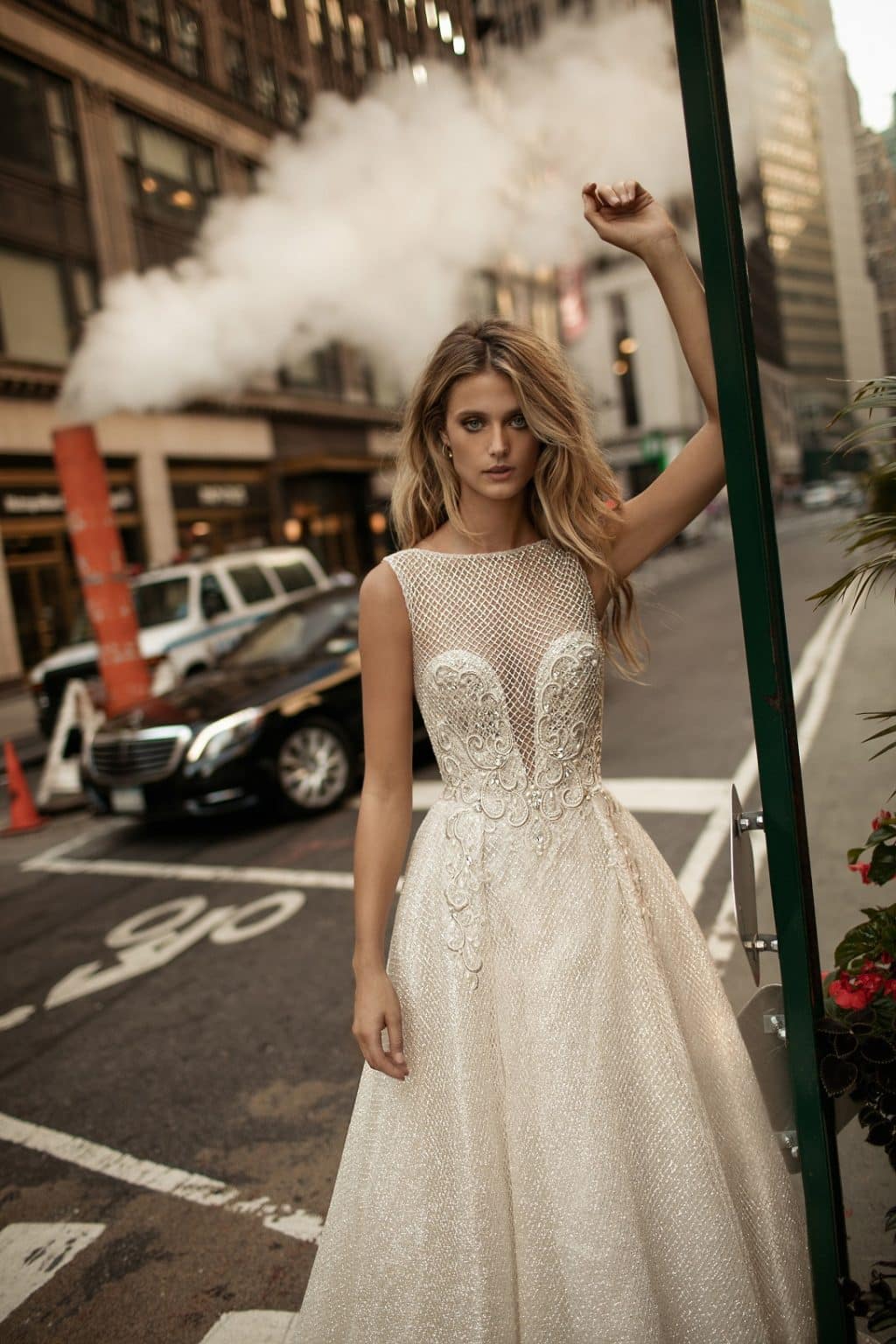
That consistency, more than any single collection, is why the name BERTA is still identified with couture work and luxury bridal at an international level.
