Vitamin C is one of the best-known ingredients in skincare. Nearly every brand now carries a vitamin C serum, and it turns up in morning-routine recommendations right alongside moisturizer and SPF. The promises rarely vary: more glow, a more even tone, fewer dark spots, collagen support, and antioxidant protection.
The size of the category is exactly what makes it so confusing. A serum with 10% vitamin C can sting like crazy, while another one labeled “15% vitamin C” feels almost like a moisturizer. A formula can be perfectly clear on day one and orange-brown a few months later. You can drop serious money on a serum and find out your skin just doesn’t like it. “Vitamin C” on a label doesn’t describe a product on its own: what form is it in? What concentration? What pH? How stable is the formula? What else is in it? And is it a formula that suits your skin type?
Research and dermatological reviews suggest that topical vitamin C can help reduce signs of photoaging, support collagen synthesis, and influence melanin production - which is why it comes up in conversations about pigmentation too. But “can work” and “every vitamin C serum works the same way” are two very different statements.
What does vitamin C actually do for skin?
Vitamin C is an antioxidant: it helps counter oxidative processes driven by UV exposure and environmental factors, among other things. Skin holds antioxidants of its own, but daily environmental exposure creates oxidative load - one reason the morning antioxidant serum caught on the way it did.
Its activity isn’t limited to antioxidant protection, though - it’s also involved in processes related to collagen production, and it has relevant activity in melanin-production pathways. Research reviews point to its use in the context of photoaging, pigmentation, and collagen support. So vitamin C in skincare really covers three directions: antioxidant protection, brightening and pigmentation, and supporting the appearance of skin that’s had chronic sun exposure. That’s also why it lands in morning routines rather than only at night.
Does vitamin C actually fade pigmentation?
“Fading pigmentation” is a phrase I can’t stand, because it sets up the expectation that a serum will simply make a dark spot disappear. But vitamin C can absolutely be part of a routine for treating dark spots. The American Academy of Dermatology (AAD) lists vitamin C among ingredients that can help fade dark spots, and DermNet also notes vitamin C as one option for treating post-inflammatory hyperpigmentation. Its activity is linked, among other things, to its effect on melanogenesis - the process by which melanin is produced.
Context matters, though. If you have PIH left over from a breakout, vitamin C can be part of the routine. If you have significant melasma, it can be part of the approach, but it’s not necessarily the only treatment needed - the AAD notes that a dermatologist may combine vitamin C with other treatments even for melasma. And if the mark is actually a new lesion you can’t identify, you don’t start with vitamin C. You get it diagnosed.
Why is it almost always recommended in the morning?
Not because vitamin C “only works in the morning” - you can use it at other times too. But morning makes strategic sense for an antioxidant, since the skin is about to take a full day of radiation and environmental stress. The AAD itself recommends a vitamin C serum or cream in the morning, before sunscreen, as part of a skincare routine.
And to be clear: vitamin C is not a substitute for SPF. It isn’t a UV filter, and it doesn’t make sunscreen optional. I think of it as a partner to SPF, not a replacement for it. A simple morning routine can be: cleanse → vitamin C → moisturizer as needed → SPF. That’s enough.
L-ascorbic acid: the form people mean by “pure vitamin C”
When people say “pure vitamin C,” they usually mean L-ascorbic acid. It’s one of the most-studied forms of topical vitamin C, and one of the trickiest to formulate. Its strength is a relatively substantial body of research behind it. Its weakness is that it isn’t especially stable - light, oxygen, and formulation conditions all get to it - which is why I wouldn’t buy an L-ascorbic acid serum on a high percentage alone. A 20% concentration that’s already oxidized isn’t automatically better than a well-formulated, stable 10-15%.
Why is L-ascorbic acid so hard to formulate? Skin is a very effective barrier - a good thing, since we don’t actually want everything we put on it sinking straight in. But for L-ascorbic acid to work in a topical formula, a brand has to solve penetration and stability at once. Scientific reviews note that L-ascorbic acid is hydrophilic and unstable, and that formulations require the right conditions to improve both penetration and stability. That’s one reason brands invest so heavily in the formulation around vitamin C - it’s not just “add some vitamin C powder to a cream.”
How much vitamin C do you actually need?
More isn’t necessarily better here. Most serums fall somewhere between 10% and 20% L-ascorbic acid, but the ideal concentration depends on the formula and on your skin’s tolerance. Some studies have found photoprotective activity from topical vitamin C at concentrations of 10% and above, but that doesn’t mean everyone should start at 20%. On sensitive skin, a high concentration can be the exact reason you quit the product - and a product you don’t use does nothing for you.
Here’s how I’d think about concentration: 5-10% is a more comfortable place to start, especially for sensitive skin. 10-15% is the most common range for L-ascorbic acid formulas. 15-20% suits someone who already knows their skin tolerates acidic vitamin C well. But the number alone is never enough.
Is 20% vitamin C twice as good as 10%?
No. Skincare loves numbers because they market well - 20% sounds more advanced than 10%. But skin doesn’t run on a linear graph where doubling the concentration doubles the payoff. And as potency climbs, so does the odds of irritation. I’d rather use a serum my skin tolerates for months than a “strong” one it tolerates for four days. This is a point I come back to in nearly every article about active ingredients: consistency beats aggression.
What are vitamin C derivatives?
Here’s where vitamin C gets genuinely interesting. Plenty of brands don’t use L-ascorbic acid at all - they use derivatives, molecules engineered to be more stable or easier to formulate. You’ll come across names like sodium ascorbyl phosphate, magnesium ascorbyl phosphate, ascorbyl glucoside, 3-O-ethyl ascorbic acid, and tetrahexyldecyl ascorbate. Each is different in structure, solubility, stability, and research base. That’s exactly why I dislike reviews that say “it’s vitamin C, but it’s only 10%” - it might not even be the same ingredient.
So which is better - L-ascorbic acid or a derivative? On research history alone, L-ascorbic acid is the reference point. In the real world there’s also your skin to consider, and if L-ascorbic acid leaves you with stinging, redness, or flaking, a stable, gentler derivative can be the much better choice. I’ll take a formula that suits the skin over an ingredient that’s “the most active” on paper. That’s especially true for sensitive skin.
Why does vitamin C serum sometimes sting, and why does it change color?
Some L-ascorbic acid formulas work at an acidic pH, which can create tingling or stinging, especially if the barrier is already compromised. But not every tingle is “proof the product is working” - that’s a myth I’d love us to stop repeating. Mild, brief tingling, with the skin calm afterward, might be fine for that particular person. If the skin is red, painful, itchy, or stinging persistently, that’s a sign to stop. Irritation is not efficacy.
And why does vitamin C serum change color? Because vitamin C can oxidize. It’s one of the most important things to understand in this category, because a lot of us hold onto a bottle for months without being sure it’s still good. L-ascorbic acid is sensitive to oxidation - over time, especially with exposure to light, air, and heat, the formula can change color. A serum that started out clear or pale yellow and is going dark yellow, orange, or brown is worth a closer look. Not every minor shift means the product is worthless, but a significant change isn’t something I’d ignore - once a formula has oxidized meaningfully, you’re no longer necessarily using the same active formula you bought.
That’s why I take packaging seriously with vitamin C: a dark bottle, a good seal, and sane storage aren’t “luxury details” - they’re part of how you protect the formula. Store it somewhere cool and shaded, tightly closed. Not on a windowsill, not near a heat source, and not sitting open for ten minutes every morning while you get ready. Some people keep certain formulas in the refrigerator, but I wouldn’t treat that as a universal rule without checking the product’s own instructions.
Vitamin C + vitamin E + ferulic acid: why this trio is everywhere
It’s the combination most closely associated with vitamin C, and it isn’t just a trend. Vitamin C and vitamin E are antioxidants that can work together, and research reviews note synergy between them in protecting against oxidative damage. Ferulic acid also functions as an antioxidant and can be part of formulation systems designed to improve stability and performance. That’s one reason serums combining C + E + ferulic acid have become almost their own category. But three names on a label don’t guarantee the formula is identical from brand to brand.
Collagen, SPF, and results - what’s true and what isn’t
Does vitamin C “protect from the sun”? Not in the way that phrase suggests. Vitamin C can contribute antioxidant protection against damage caused by UV exposure, but it is not a sunscreen - it isn’t meant to replace UV filters, and it doesn’t give you license to use less SPF. SPF works by reducing the amount of radiation that reaches the skin. Antioxidants like vitamin C can be an additional layer of support against oxidative stress. These are different mechanisms, and that combination is exactly why morning is such a popular time to use it.
Does vitamin C really help with collagen? Vitamin C is a cofactor in processes related to collagen synthesis, and there are clinical and lab studies supporting its role in aging and photoaged skin. Research reviews point to effects on collagen synthesis and stability, and one clinical study found visible improvement in fine lines after 12 weeks of topical use of a vitamin C formula. Here too, I’d separate “supporting collagen biology” from “a serum that lifts your face” - vitamin C doesn’t give you a facelift. It can be part of a long-term anti-aging routine, but the results are gradual and far more modest than the marketing around it suggests.
How long does vitamin C take to work? Depends what you’re measuring. Glow and a general sense of brighter skin can show up well before any meaningful change in dark spots. Clinical studies on photoaging have used timeframes of weeks to months - 12 weeks, for example, in one wrinkle study. So I don’t judge a pigmentation serum after ten days - I’d look more at 8-12 weeks, assuming consistent use and SPF.
Vitamin C by skin type
Oily skin: Vitamin C isn’t “just moisturizer for dry skin” - but the formula changes everything. A light, watery serum can work beautifully on oily skin, while a very rich one can feel like too much. If the skin is also acne-prone, read the full ingredient list, not just the vitamin C.
Dry skin: I want a formula that also brings humectants and moisture-supporting ingredients. Dry skin can absolutely benefit from vitamin C, but an acidic L-ascorbic acid in a minimalist formula is rough going if the skin is already tight and irritated - a richer vitamin C cream or serum suits it better than an aggressive product sold mainly on “high percentage.”
Sensitive skin: This is where I’m most conservative. If L-ascorbic acid has already proven it stings, the answer isn’t a higher concentration “so the skin gets used to it.” You can try a lower concentration, a more stable derivative, a fragrance-free formula without a heavy load of other irritating ingredients - or simply skip it. Vitamin C is an excellent ingredient; it isn’t a biological requirement in a skincare routine.
Pregnancy: The AAD includes vitamin C as one of the ingredients that can be considered in a pregnancy skincare routine, and even recommends it in the morning in the context of skin-tone changes during pregnancy. Still, during pregnancy it’s always worth looking at the entire formula, not just the hero ingredient - if there’s another active ingredient you’re unsure about, check it.
Combinations - retinol, acids, niacinamide, and azelaic acid
Can you combine vitamin C and retinol? Yes. The simplest approach is vitamin C in the morning and retinol at night - not because some chemical rule forbids using them together, but because separating them is easier on both the skin and the routine. On very sensitive skin, I also wouldn’t start both in the same week. I want to know which product is doing what.
Vitamin C and acids - allowed? “Allowed” isn’t really the question. You can combine vitamin C and acids in a routine, but if you’re running acidic L-ascorbic acid in the morning, glycolic acid at night, and retinol on top of that, the real question is whether your skin can take that pace. If it can, great. If not, splitting things across different days makes far more sense. A routine doesn’t need to prove how many actives you can cram into it.
Vitamin C and niacinamide - really forbidden? One of the most stubborn myths in skincare. The fear of combining them rests largely on interpretations of old data and test conditions that don’t necessarily reflect modern skincare formulas. Modern formulations put them together all the time. The question, again, isn’t whether the two ingredients are at war - it’s whether the formula is good and your skin likes it.
Vitamin C and azelaic acid - you can absolutely build a routine around both, especially when pigmentation and PIH are the concern. You don’t have to stack them in the same moment, though: vitamin C in the morning and azelaic acid at night works well. On sensitive skin, that’s how I’d rather start.
Vitamin C under makeup
Nobody talks about this enough, and it matters. A vitamin C serum can be great for skin and still be miserable under foundation. If it’s tacky, rolls up, sits heavy, or fights the SPF layered over it, you get pilling. So in the morning I keep layers thin, let the serum settle before I move on, skip a heavy moisturizer when the SPF is hydrating enough, and only then go in with makeup. The more steps you stack before foundation, the better the odds something starts rolling up.
The brands people keep asking me about
Is an expensive serum actually better? Not necessarily. But vitamin C is one of the categories where formulation genuinely costs money - you’re not just paying for the raw ingredient, you’re paying for a stabilization system, pH, packaging, antioxidant pairing, stability testing, a delivery system, and texture. An expensive brand isn’t automatically better, but “vitamin C is vitamin C, why pay more?” is too simplistic - especially with L-ascorbic acid.
The Ordinary. A perfect illustration of how confusing this category gets. Over the years the brand has offered several different forms and formulas, which is its strength and its weakness at once: you can choose by the type of vitamin C you want, but a shopper who doesn’t know the differences is staring at six products that all look like they do the same thing. I’d start less from “which is strongest?” and more from “which formula actually suits me?”
Clinique. Worth a look if you want vitamin C from a brand whose formulation philosophy also centers sensitive skin, with a lot of fragrance-free products across the line. Even so, check the specific product - I don’t give a brand a free pass just because it’s associated with sensitive skin. Vitamin C can be active and irritating even in a formula from a brand I like.
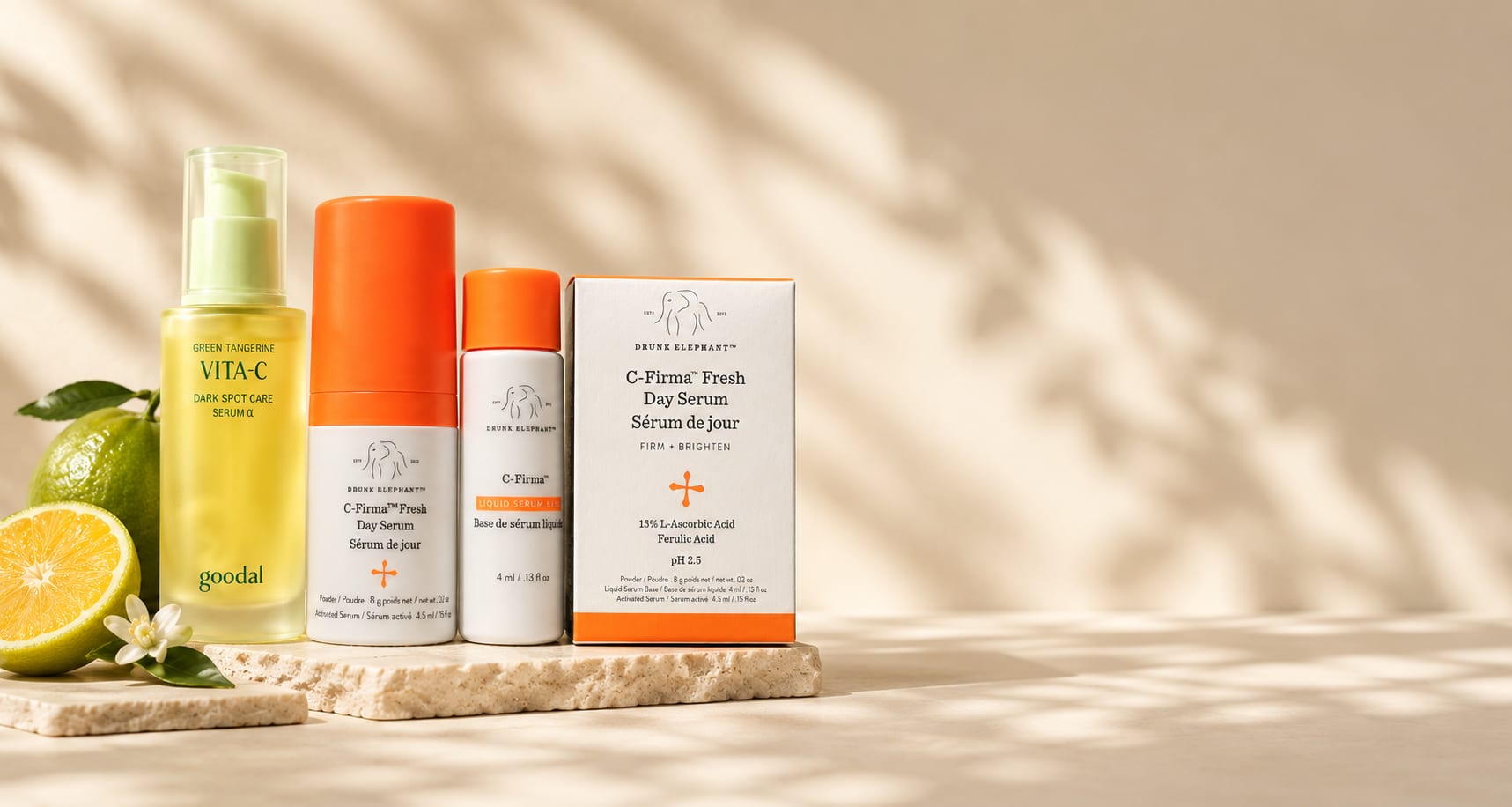
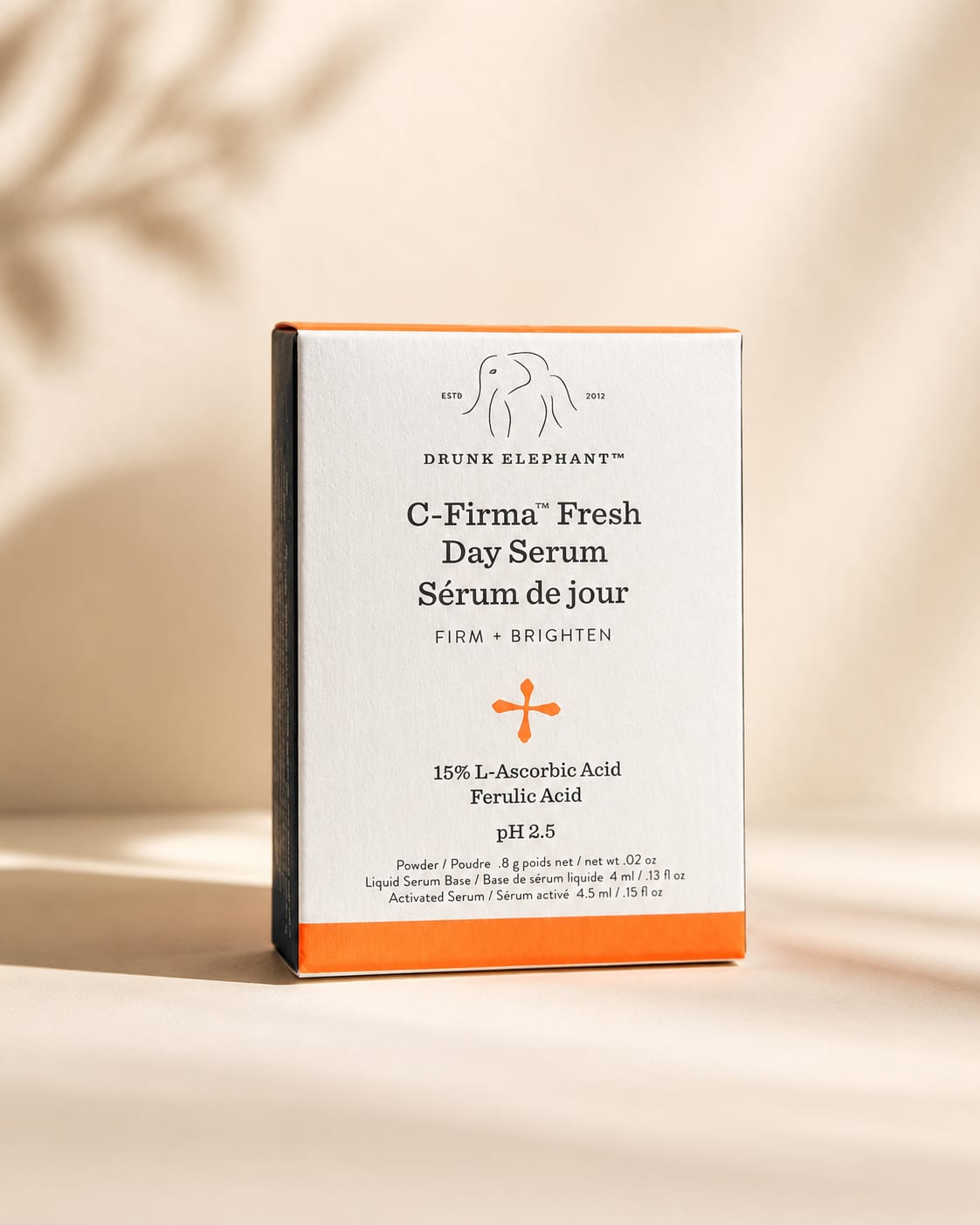
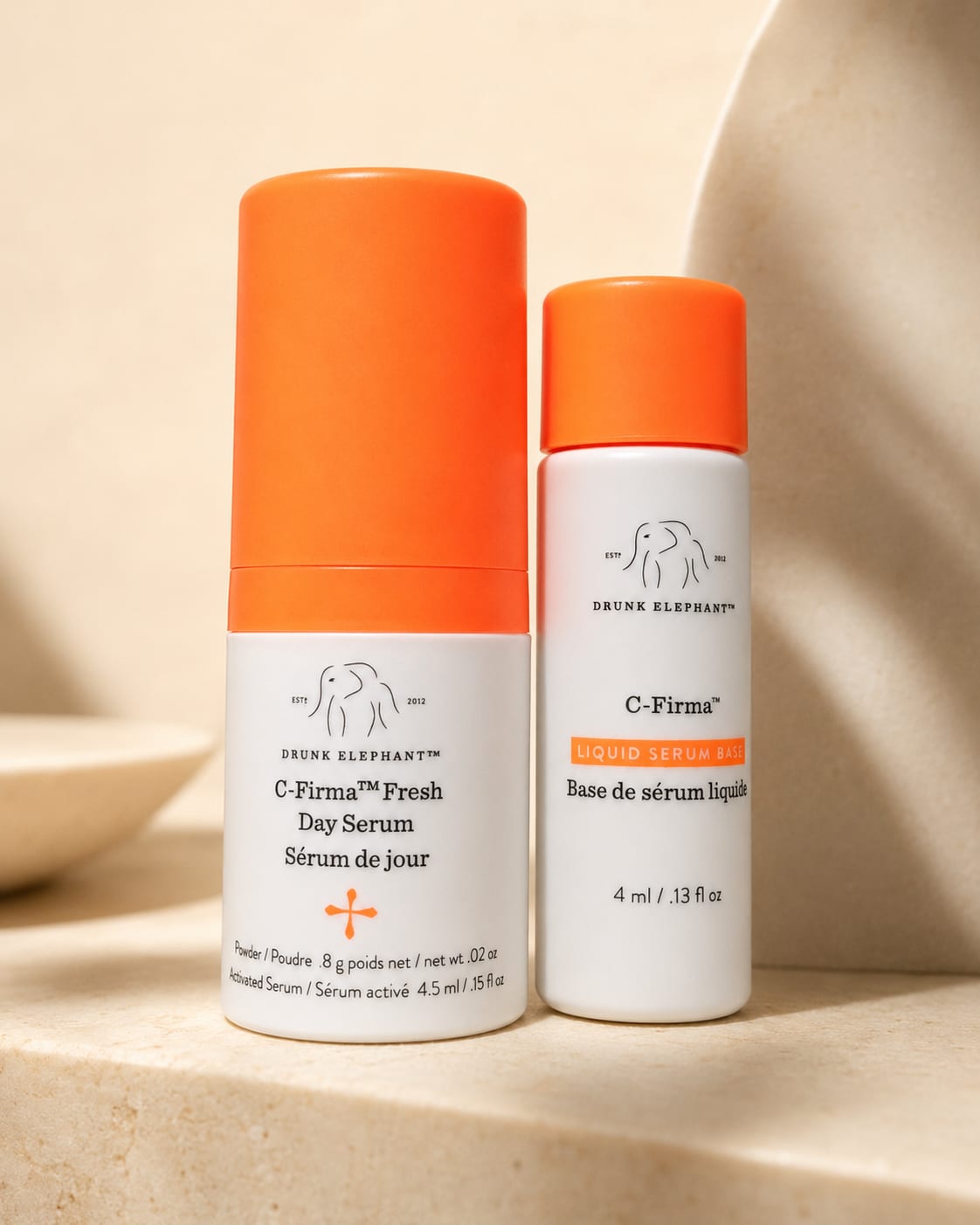
Drunk Elephant C-Firma. C-Firma has become one of the most recognizable vitamin C serums in prestige, largely because it combines vitamin C with vitamin E and ferulic acid - the family of formulas that set the standard for the “morning antioxidant serum.” What I like about the concept is that it isn’t selling vitamin C alone, it’s selling an antioxidant system. For sensitive skin, though, a strong L-ascorbic acid formula is a challenge. My take isn’t that it suits everyone - it’s that it shows very clearly what an advanced vitamin C serum is trying to do.
Sunday Riley C.E.O. Sunday Riley went a different direction with C.E.O., building it on a vitamin C derivative rather than classic L-ascorbic acid. That’s interesting for anyone who likes vitamin C but can’t get along with the acidic feel of L-AA. It’s exactly the case where a derivative isn’t “a lesser version” - sometimes it’s just the version that suits a particular person better.
SkinCeuticals C E Ferulic. You can’t write a guide like this without addressing it. C E Ferulic is almost the reference point for the antioxidant-serum category: L-ascorbic acid + vitamin E + ferulic acid. The price is very high, which makes it a perfect test case: are we paying for a name, or for formulation? There’s real research and a very well-established formulation behind it, so I understand its standing. But does everyone need to spend that to get a good vitamin C? No.
Timeless Vitamin C + E Ferulic. Timeless is the name people keep coming back to when they want that same C + E + ferulic concept at a more accessible price. It’s the kind of product worth judging on more than “is this a dupe of SkinCeuticals?” - look at stability, packaging, texture, pH, tolerability, and whether the savings come with a real compromise.
So which vitamin C is best? There’s no single winner. If you want classic L-ascorbic acid with a strong antioxidant system, that’s a different direction from a gentle formula for sensitive skin. Dry skin may prefer a cream or emulsion; oily skin, a watery serum. And if every vitamin C you’ve tried has stung? Maybe vitamin C doesn’t need to be the hero of your routine at all.
Where to start if you’re new to vitamin C
Morning: gentle cleanser → vitamin C → moisturizer if needed → SPF. That’s it. There’s no reason to open with an acid toner, vitamin C, niacinamide, a peptide serum, an essence, a moisturizer, an oil, and SPF all at once. If your skin loves an elaborate routine, great. But complexity isn’t the goal.
Common mistakes with vitamin C
The biggest one is buying on percentage alone - 20% tells you nothing about the type of vitamin C, the formula’s stability, or its quality. Then there’s hanging onto an oxidized serum and using it anyway because “it feels wasteful to throw it out.” And starting a strong vitamin C the same week as a new retinol and a new acid - if your skin reacts, you have no idea which product to blame. And of course: vitamin C without SPF is a very partial strategy if your goal is pigmentation and photoaging.
Which vitamin C fits which goal?
| Goal/skin type | Direction to consider |
|---|---|
| Beginner | Moderate concentration or an easy-to-tolerate derivative |
| Sensitive skin | Derivative / lower L-AA + a simple formula |
| Oily skin | Lightweight, non-greasy serum |
| Dry skin | Formula with humectants/emollients |
| Pigmentation | Vitamin C as part of a broader routine + SPF |
| Photoaging | A quality L-AA formula can be worth considering |
| Melasma | Only as part of a broader strategy |
| Doesn’t get along with vitamin C | You don’t have to use it |
Frequently asked questions about vitamin C for skin
Pigmentation and results
Does vitamin C really help with pigmentation? Yes, vitamin C can fit into a routine aimed at improving the look of dark spots and uneven tone. It doesn’t “erase” a mark on its own, but it can influence melanin-related pathways and pairs well with SPF and other treatments. For significant melasma or stubborn pigmentation, I wouldn’t rely on it as the only treatment.
How long until you see results from vitamin C? Glow and a general improvement in skin appearance can show up before a significant change in dark spots. For pigmentation, think in terms of weeks to months, not days. Consistent use and SPF matter far more than switching serums every two weeks.
Does vitamin C help with acne scars? It can help the appearance of flat marks left after acne - that is, PIH. It doesn’t “fill in” indented scars and doesn’t fix deep textural scarring on its own.
Does vitamin C help with melasma? It can be part of a melasma-treatment routine, but melasma is more complex than a regular spot and tends to recur. In that case, diligent SPF - and sometimes medical treatment - matters more than relying on a single serum.
Is vitamin C good for wrinkles? It can fit into an anti-aging routine because of its relevance to antioxidant activity and collagen-related processes. But it doesn’t erase deep wrinkles and doesn’t replace a medical treatment or procedure.
Does vitamin C help with pores? I wouldn’t choose it mainly for pore size. If pores look less prominent as a result of overall improved texture and skin quality - great, but that’s not its main specialty.
Concentrations and types of vitamin C
Which is better - 10%, 15%, or 20% vitamin C? There’s no single number that suits everyone. 20% isn’t automatically better than 10%. You need to know what form of vitamin C it is, what the pH is, how stable the formula is, and how your skin responds. For sensitive skin, I’d generally start lower rather than chasing the highest percentage.
Is 5% vitamin C even effective? Yes, especially for sensitive skin or a well-formulated product. A lower concentration can be preferable if it allows for consistent use without irritation. Percentage alone doesn’t determine a product’s quality.
What’s the difference between ascorbic acid and L-ascorbic acid? In skincare, L-ascorbic acid is the most active and most studied form of vitamin C. Sometimes the ingredient list will simply say “ascorbic acid.” It’s effective, but also less stable and can be more challenging for sensitive skin.
What’s the difference between pure vitamin C and a derivative? L-ascorbic acid is the purest, most-researched form, but it’s sensitive to oxidation and can sting. Derivatives like ascorbyl glucoside, sodium ascorbyl phosphate, or tetrahexyldecyl ascorbate can be more stable and gentler - I wouldn’t automatically treat them as “lesser.”
By skin type
What’s the best vitamin C for sensitive skin? I’d generally look for a moderate concentration, a more stable derivative, and a fragrance-free formula without an excess of other actives. If acidic L-ascorbic acid keeps burning, there’s no reason to insist on it.
Is vitamin C good for oily skin? Yes. Skin type doesn’t rule out using vitamin C. What matters is the texture of the product - for oily skin, I’d look for a lightweight serum that isn’t greasy or too heavy under SPF.
Is vitamin C good for dry skin? Yes, but for dry skin I prefer a formula that also contains moisturizing ingredients, not just an active acid. If the skin is already tight and irritated, a very acidic serum can be too much.
Is vitamin C good for acne-prone skin? It can absolutely suit acne-prone skin, especially if PIH marks are left after breakouts. But if the acne itself is still active, that needs to be addressed too, not just the marks it leaves behind.
Is vitamin C good for the neck and chest? Yes, as long as the skin in that area tolerates the formula. The chest is also very sun-exposed, so pairing it with SPF matters especially there.
Can you use vitamin C around the eyes? Only carefully, and depending on the formula. The eye area is more sensitive, so I wouldn’t apply a strong L-ascorbic acid right up to the lash line by default.
Is vitamin C safe during pregnancy? Vitamin C is generally considered one of the ingredients that can be used during pregnancy, but you should check the entire formula, not just the hero ingredient. If in doubt, talk to your doctor.
Use and combinations
Can you use vitamin C in the morning? Yes, and that’s the most common use. It fits well into a morning routine because of its antioxidant activity. Follow it with SPF.
Can you use vitamin C at night? Yes. It doesn’t “stop working” after dark. Most of us just prefer it in the morning and save retinol for the evening.
Do you have to use it every day? Not necessarily. Skin that tolerates the formula well can use it daily, but sensitive skin might start with two or three times a week, or every other day.
What goes on first - vitamin C or hyaluronic acid? In most cases, a thin vitamin C serum goes on first, followed by hyaluronic acid or a hydrating serum - but always check the manufacturer’s instructions and the specific textures involved.
What goes on first - vitamin C or niacinamide? You can use both, and there’s no need to fear the myth that they can’t be combined. In most cases I’d go by texture - thinner first - or use one in the morning and the other at night if the skin is sensitive.
Can you combine vitamin C and retinol? Yes. The simplest approach is vitamin C in the morning and retinol at night, so you get the benefit of both without overloading either into the same routine.
Can you combine vitamin C and glycolic acid? You can, but not every skin needs both in the same routine. For sensitive skin, I’d separate them by day, or by morning versus evening.
Can you combine vitamin C and azelaic acid? Yes. A common, convenient combination is vitamin C in the morning and azelaic acid at night, especially for PIH.
Vitamin C or retinol - if you can only buy one? It depends on your goal. Vitamin C especially suits a morning routine, antioxidants, and brightening. Retinoids work more broadly on acne, turnover, texture, and signs of aging - they aren’t direct substitutes for each other.
Vitamin C or azelaic acid for pigmentation? If the pigmentation is linked to acne and inflammation, azelaic acid can be especially interesting. Vitamin C suits a brightening-and-antioxidant routine especially well. You can also combine the two.
Vitamin C or glycolic acid? Glycolic acid works mainly through exfoliation and turnover, while vitamin C isn’t a peeling agent. The choice depends on your skin type and what you’re actually trying to treat.
Problems and storage
Why does vitamin C make my skin sting? L-ascorbic acid sometimes works at an acidic pH, which can cause tingling. But significant stinging, ongoing redness, or flaking aren’t a sign “the product is working better” - they can mean the formula is too strong for your skin.
Should you stop if vitamin C burns? If it’s significant or ongoing burning - yes. I’d stop, let the skin calm down, and then consider a gentler product or a different derivative.
Why did my serum turn orange or brown? That can be a sign of oxidation, especially in L-ascorbic acid formulas. A slight shift doesn’t always mean the product is completely ruined, but a significant change to dark yellow, orange, or brown is worth a closer look.
Can you use vitamin C that’s already oxidized? Once a formula has oxidized, it’s no longer the same formula you bought. If the color change is significant, it’s better not to keep using it just to avoid “wasting” it.
How should you store a vitamin C serum? Somewhere cool and shaded, with the bottle tightly closed. Not on a windowsill, not near a heat source. If the brand recommends refrigeration, follow its instructions.
Do you need to keep vitamin C in the fridge? Not every product. Some formulas do benefit from cool storage, but there’s no universal rule that every vitamin C serum must be refrigerated - follow the brand’s own instructions.
Why does vitamin C sometimes smell strange? Some formulas, especially those with ferulic acid, can have a characteristic smell that doesn’t necessarily indicate spoilage. A significant change in smell along with a change in color and texture does warrant a closer look.
Can vitamin C cause breakouts? Vitamin C itself usually isn’t the direct cause. A full formula can be heavy or oily - look at the entire ingredient list, not just the hero ingredient.
Can vitamin C dry out skin? Certain formulas absolutely can cause dryness or irritation, especially at higher concentrations. You can reduce frequency, add moisture, or switch to a gentler formula.
General
Is vitamin C a must-have in a skincare routine? No. It’s an excellent ingredient with real benefits, but a routine can be very good without it - cleansing, moisturizing, and sun protection are the genuinely essential parts.
What’s the best vitamin C for beginners? I’d generally choose a moderate, stable formula that isn’t overloaded with additional actives - not jump straight to 20% L-ascorbic acid just because it sounds “more effective.”
How do you know vitamin C is actually working? Not by tingling. I’d look, over time, for improved glow, a more even tone, and gradual fading in the appearance of dark spots, with consistent use and SPF alongside it.
Is an expensive vitamin C serum really better? Not necessarily, but this is a category where formulation, stability, and packaging can genuinely justify part of the price. There are also accessible products with very good formulas.
Do you need SPF when using vitamin C? Yes - especially if your goal is pigmentation or photoaging. Vitamin C is not a substitute for sun protection, and SPF is one of the most important steps in a routine like that.
What if vitamin C just doesn’t work for me? Then you don’t need it. There’s azelaic acid, niacinamide, retinoids, other acids, and other treatments depending on your goal - no single ingredient is mandatory for every type of skin.
The bottom line - vitamin C isn’t a product, it’s a category
If you take one thing from this guide, take this. When someone tells me “vitamin C doesn’t work for me,” I want to know: which one? L-ascorbic acid? At what concentration? What pH? What formula? Or a derivative? Vitamin C isn’t one product, the same way “acid” isn’t one product. There are strong, acidic formulas, there are gentler derivatives, there are complex antioxidant serums, and there are products that include vitamin C mainly so they can put it on the front of the box.
That’s why I don’t shop by the highest percentage, the highest price, or whichever bottle the most influencers are holding on camera. I look at the formula first, then at whether it suits my skin, then at consistency - and when pigmentation or photoaging is the goal, always at SPF too. Vitamin C can be one of the best things you add to a morning routine, but it works best once you stop treating it as a “magic brightening serum” and start seeing what it actually is: an active antioxidant with real potential, in the right routine, in the right formula, on the right skin.