
There are foundations I love, and there are foundations I refuse to work without.
Giorgio Armani Luminous Silk Foundation is the second kind. I’m addicted to it. It’s my ride-or-die foundation, and I keep going back to it even with a kit full of other options.
The reason is simple. I love the skin I get out of it. Even, polished, and still recognizably skin. I can lay it on sheer, I can build it up, and I can mix it with other formulas to shift the finish and the wear time.
Even on oily skin I don’t necessarily give it up. I’ll mix it with a matte foundation, take back control of shine and staying power, and keep the look I love in Luminous Silk.
Armani makes more than one foundation formula, though, and choosing within Luminous Silk is far trickier than it looks.
The current range runs 44 shades, and the number on the bottle isn’t just a slider from light to dark. Every shade carries a depth and an undertone, so two numbers that sit close together can behave completely differently on skin.
The Armani foundation lineup at a glance
| Product | Coverage | Finish | Who it suits |
|---|---|---|---|
| Luminous Silk Foundation | Medium, buildable | Natural Glow | Anyone who wants skin that’s alive, polished, and natural |
| Power Fabric+ | Medium to full | Natural Matte | Anyone who wants more coverage and control over shine |
| Neo Nude | Very light | Very natural | Anyone looking for a feel closer to a skin tint |
Luminous Silk is the star of the category for me. Power Fabric+ solves a completely different problem, and Neo Nude lives at the lighter, sheerer end of the scale.
Giorgio Armani Luminous Silk Foundation - my ride-or-die
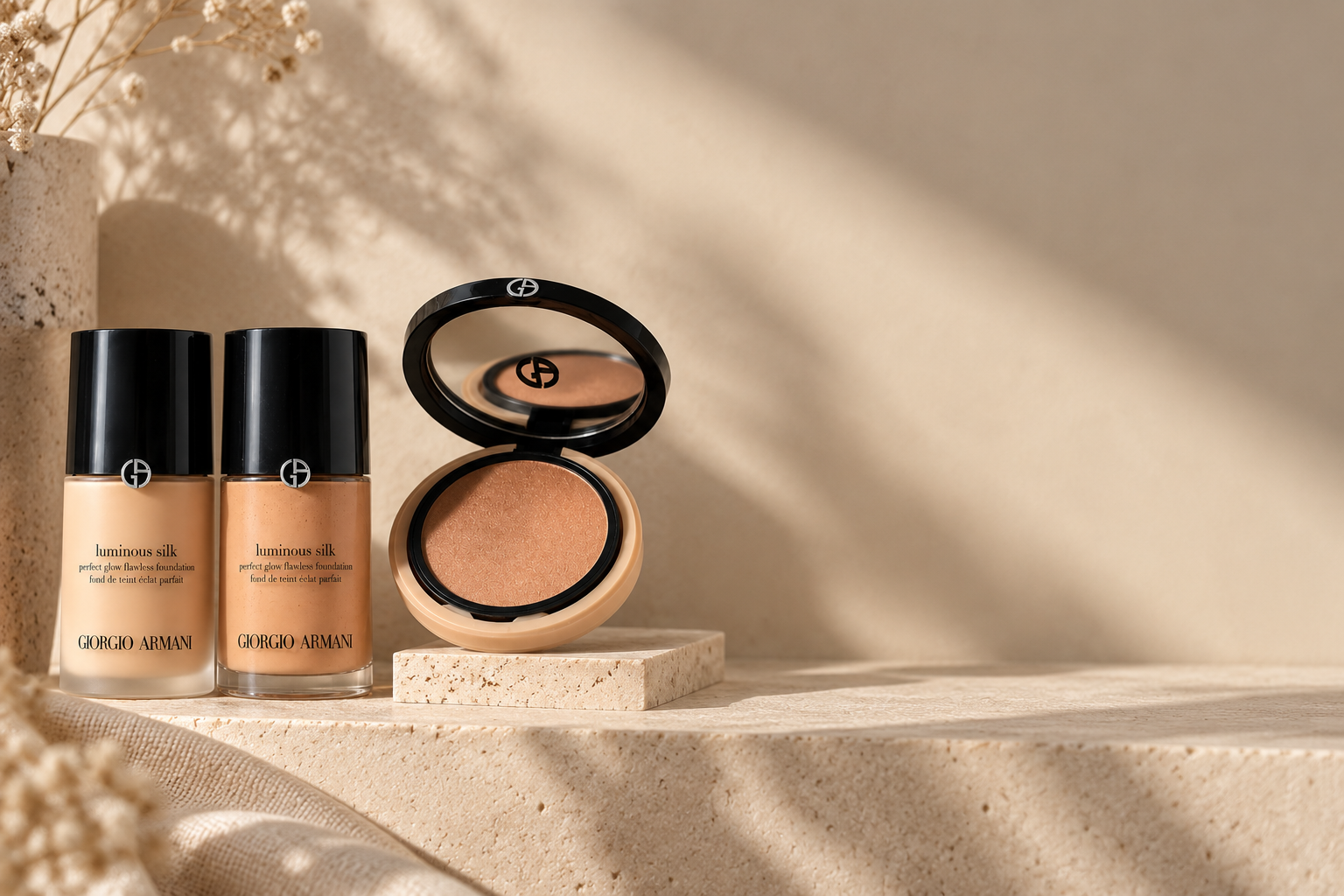
10/10. Ride or Die.
One Armani foundation, no debate: Luminous Silk.
Armani defines the current formula as medium, buildable coverage with a Natural Glow finish. The range has been expanded to 44 shades.
The word Glow is a little misleading, though. This isn’t a shiny or wet foundation. What I love is that skin picks up life and light without looking like I dropped a shimmering layer over it.
I can go paper-thin where the skin already looks good, then build coverage only where it’s actually needed.
In professional work, and especially in bridal, that flexibility is everything. I don’t want the same amount of foundation on the forehead, the cheeks, the nose, and the chin. I want to build skin according to what it needs, and Luminous Silk lets me do exactly that.
Does Luminous Silk suit oily skin?
Yes, though I don’t always use it alone. I love the finish too much to abandon it just because the skin is oily.
When I want more staying power and more control over shine, I mix it with a matte foundation. Same look I love, adapted to the skin in front of me.
It’s also why I don’t believe in hunting for the one foundation that works on everyone. Sometimes the formula you want lives between two bottles.
What changed in Luminous Silk?
The range went through a significant update. Armani explicitly states that some shades have changed and that the current formula includes an update to the pigment system. Among other things, the brand added an ultramarine blue pigment to the olive shades to make the match more precise.
Before you reorder the same number: if you’ve worn one number for years, don’t reorder it blind. An identical number doesn’t guarantee the new match reads the way you remember.
Understanding Luminous Silk’s 44 shades
This is where a lot of people trip up, makeup artists new to the line included.
Don’t choose Luminous Silk by number alone.
You need to look at two things:
- Depth - Fair, Light, Light Medium, Medium, Medium Tan, Tan, Deep, or Very Deep.
- Undertone - Pink, Peach, Golden, Olive, and in some of the deeper shades, Red or Neutral.
Take 3.75 Fair Cool Pink against 4.5 Light Neutral Peach. 4.5 isn’t 3.75 with the brightness turned down. It’s deeper and it belongs to a different undertone family entirely. That’s how Armani’s current, updated 44-shade map is built.
Pink - Luminous Silk shades with a pink undertone
If your skin runs genuinely pink, these are the shades to know.
| Shade | Depth | Undertone |
|---|---|---|
| 3.75 | Fair | Cool Pink |
| 5 | Light | Neutral Pink |
| 5.1 | Light | Cool Pink |
| 5.25 | Light Medium | Cool Pink |
| 5.9 | Medium | Neutral Pink |
| 8.25 | Tan | Cool Pink |
| 11.75 | Deep | Neutral Pink |
| 12.1 | Deep | Cool Pink |
3.75 - the one to know for fair, rosy skin. 3.75 is Fair Cool Pink, and it’s the lightest Cool Pink in the range. Nothing below it holds that undertone.
There are lighter shades - 1 Fair Cool Peach, 2 Fair Neutral Golden, and 3 Fair Warm Golden. None of them is Pink.
So when 3.75 is right on undertone but a touch too dark, I don’t jump to 2 just because it’s lighter. That fixes the depth and breaks the color family. On a job, I’d rather lighten 3.75 by mixing and hold onto the rosy direction I need.
Peach - the peachy shades
Peach is one of the most interesting undertones in the range, sitting right between pink and yellow.
| Shade | Depth | Undertone |
|---|---|---|
| 1 | Fair | Cool Peach |
| 3.5 | Light | Neutral Peach |
| 3.8 | Light | Warm Peach |
| 4.5 | Light | Neutral Peach |
| 5.2 | Light Medium | Warm Peach |
| 5.5 | Light Medium | Cool Peach |
| 5.95 | Medium | Neutral Peach |
| 6.25 | Medium | Warm Peach |
| 7 | Medium Tan | Cool Peach |
| 9.1 | Tan | Warm Peach |
| 11.8 | Deep | Warm Peach |
What makes 4.5 worth singling out. 4.5 is Light Neutral Peach. That detail matters, because people start treating it as the tan-skin shade when Armani officially places it in Light.
Even so, it’s a genuinely useful working shade for anyone who looks relatively tan within the lighter range, especially when the skin isn’t pink but isn’t distinctly yellow or olive either. It’s one of the hardest-working shades in my kit.
I still wouldn’t sell it as the tan shade. Someone tan can be Peach, Golden, Olive, or Pink. Depth first, undertone second.
Golden - the golden family
Golden is for skin with a clear yellow-gold cast.
| Shade | Depth | Undertone |
|---|---|---|
| 2 | Fair | Neutral Golden |
| 3 | Fair | Warm Golden |
| 4 | Light | Neutral Golden |
| 4.1 | Light | Warm Golden |
| 5.15 | Light Medium | Neutral Golden |
| 5.75 | Light Medium | Neutral Golden |
| 5.8 | Medium | Warm Golden |
| 6.5 | Medium | Neutral Golden |
| 6.8 | Medium Tan | Warm Golden |
| 7.6 | Medium Tan | Neutral Golden |
| 8.1 | Medium Tan | Warm Golden |
| 8.6 | Tan | Neutral Golden |
| 10.1 | Tan | Warm Golden |
| 11.4 | Deep | Warm Golden |
| 13.25 | Deep | Neutral Golden |
| 14 | Very Deep | Warm Golden |
Don’t take the shortcut of assuming any skin that isn’t pink must be Golden. That assumption is exactly what the Olive family exists to correct.
Olive - the olive shades
| Shade | Depth | Undertone |
|---|---|---|
| 5.3 | Light Medium | Neutral Olive |
| 6 | Medium | Neutral Olive |
| 7.8 | Medium Tan | Warm Olive |
| 9 | Tan | Neutral Olive |
| 11 | Deep | Neutral Olive |
| 13.6 | Very Deep | Neutral Olive |
| 13.8 | Very Deep | Warm Olive |
Olive skin is where a foundation that looked perfect in the bottle turns too pink, too peachy, or too orange on the face. That’s why 5.3 and 6 get so much of my attention in a professional kit.
They’re useful beyond an exact match, too. A client doesn’t have to be a dead match for 5.3 - a little of it dropped into another mix pulls the whole thing olive.
This family also got special attention in Armani’s current update, with the addition of an ultramarine blue pigment to the olive shades.
If you’re fairer than 3.75
Three shades sit below it right now.
| Shade | Undertone |
|---|---|
| 1 | Cool Peach |
| 2 | Neutral Golden |
| 3 | Warm Golden |
| 3.75 | Cool Pink |
Here’s the catch: nothing lighter than 3.75 holds a Cool Pink undertone.
So when 3.75 is right on undertone and only too dark, I lighten it by mixing. I’m not going to solve a depth problem by creating an undertone problem.
The Luminous Silk shades I’d keep in a pro kit
Building a professional kit from scratch today, I wouldn’t buy 44 shades. It’s expensive, it eats space, and some bottles would sit untouched for years. Above all, it’s unnecessary if you know how to mix.
I think in anchor shades instead.
- 2 Fair Neutral Golden - a very fair anchor that can also be used to lighten mixes.
- 3.75 Fair Cool Pink - very important so that not every fair client ends up with a yellow-based match.
- 4.5 Light Neutral Peach - a very useful working shade in the lighter range.
- 5 or 5.25, the Pink family - to keep a rosy anchor at a slightly deeper level too.
- 5.3 Light Medium Neutral Olive - both for olive skin and for correcting mixes.
- 5.75 Light Medium Neutral Golden
- 6 Medium Neutral Olive
- 6.5 Medium Neutral Golden
And for a kit that works with a broader range of skin tones, I’d also add 7.6 Medium Tan Neutral Golden and/or 7.8 Medium Tan Warm Olive.
This isn’t an official Armani list for makeup artists. It’s how I’d personally build an efficient working kit out of their range.
I’d keep a lightening mixer on hand too, instead of buying every possible variation of every depth.
How I read an undertone
I don’t pick a foundation off redness in the cheeks. Someone can be very red through the center of the face and still be Golden or Olive.
I look at the jawline, the neck, and the chest, and I look for the shade that creates continuity between them.
- Pink - a genuinely rosy tendency.
- Peach - sitting between pink and yellow.
- Golden - a yellow-golden tendency.
- Olive - an olive quality, sometimes reading slightly greenish or grayish.
My goal isn’t to correct the skin’s color with foundation. It’s to find a base that nearly disappears into it.
Power Fabric+ - when I want more coverage and a more matte finish
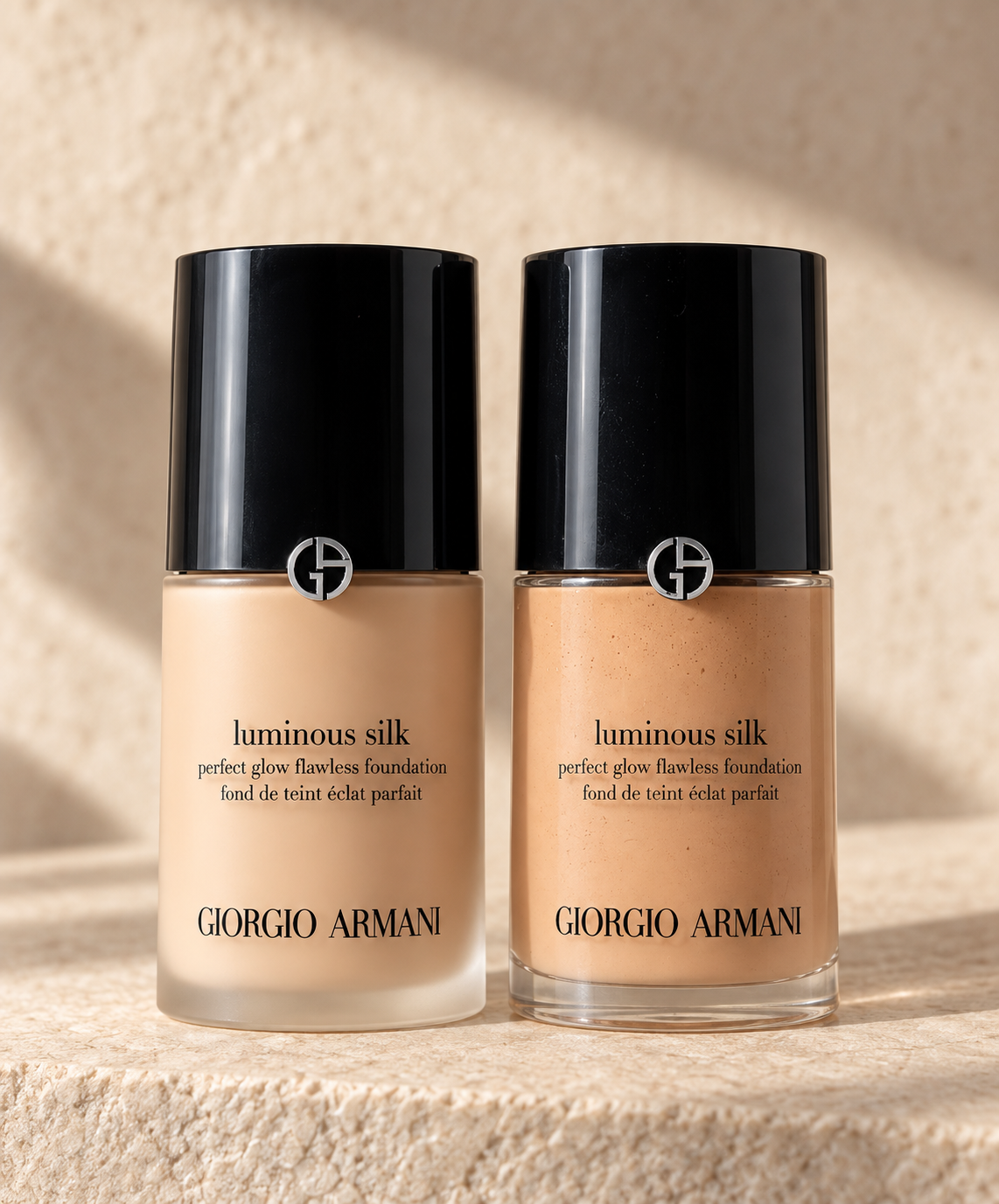
Not everyone who loves Armani needs Luminous Silk. Power Fabric+ is aimed somewhere else entirely.
Armani defines it as a medium-to-full-coverage foundation with a Natural Matte finish and up to 24 hours of wear. The brand also states resistance to transfer, sweat, heat, and water.
If Luminous Silk gives me live, luminous skin, Power Fabric+ gives me control over coverage and shine. That matters most to anyone who wants a matte finish from the start rather than powdering their way there.
The split is straightforward. Luminous Silk: live, polished skin, buildable coverage. Power Fabric+: more coverage, more shine control, a more matte finish.
Neither is better. They’re built for different results. And on a job I don’t always have to pick one, because if I want a matte formula’s wear time with the look of Luminous Silk, I mix.
Neo Nude - the lighter side of Armani
Neo Nude sits at the lighter end of the scale. Less a classic foundation than a formula living close to skin-tint territory.
It’s for anyone who hates feeling a base on their face and mostly wants the tone evened out and the skin looking natural.
Put simply: Luminous Silk is a foundation with real, buildable coverage, and Neo Nude is much lighter and sheerer.
I’m keeping it in this guide for the sake of Armani’s history and formula range, but I wouldn’t count on it being available the same way in every market.
Picking your Armani foundation
Want natural, polished, luminous skin with buildable medium coverage? Luminous Silk.
Want more coverage and a Natural Matte finish? Power Fabric+.
Want a very lightweight base, closer to a skin tint? Neo Nude sits on the sheerer side.
And if you’re asking which one I won’t take out of my kit: Luminous Silk. No real debate.
Frequently asked questions about Armani Luminous Silk
What’s the lightest pink shade in Luminous Silk? 3.75 Fair Cool Pink - there’s currently no lighter Cool Pink shade in the range.
Is 4.5 pink or neutral? Neither - it’s Light Neutral Peach.
Does 4.5 work on tan skin? It’s officially a Light-depth shade, but in my experience it’s a very useful working shade for lighter-range skin that reads somewhat tan.
Which Luminous Silk suits olive skin? See the Olive family above (5.3, 6, 7.8, 9, 11, 13.6, 13.8).
What’s the difference between Neutral Peach and Neutral Golden? Peach sits between pink and yellow; Golden leans more distinctly yellow-gold.
How do you know if you’re Pink or Peach? Look at the jawline, neck, and chest for continuity - a genuine rosy tendency points to Pink, a place between pink and yellow points to Peach.
Does Luminous Silk suit dry skin? The buildable, glow finish tends to sit well on dry skin; a richer moisturizer underneath helps.
Does Luminous Silk suit oily skin? Yes, though I often mix it with a matte foundation for more control over shine and staying power - see above.
Does Luminous Silk suit bridal makeup? Yes - it’s my personal ride-or-die for professional work, including bridal.
Can you mix two Luminous Silk shades? Yes - that’s central to how I build precise matches, especially at the edges of the shade range.
How many shades does a makeup artist really need? Far fewer than the full 44 - see my anchor-shade kit list above.
Where’s the right place to test a foundation shade? The jawline, neck, and chest - not the back of the hand.
The bottom line
Luminous Silk isn’t my ride-or-die because it’s iconic. I don’t choose products on history or the name on the bottle.
I keep going back because I love the skin I get from it. I can work it thin. I can build it up. I can mix it with a matte foundation. And I can mix its own shades against each other until the match is exactly right.
A good professional foundation doesn’t dictate how skin has to look. It gives me enough control to build the skin I want.


