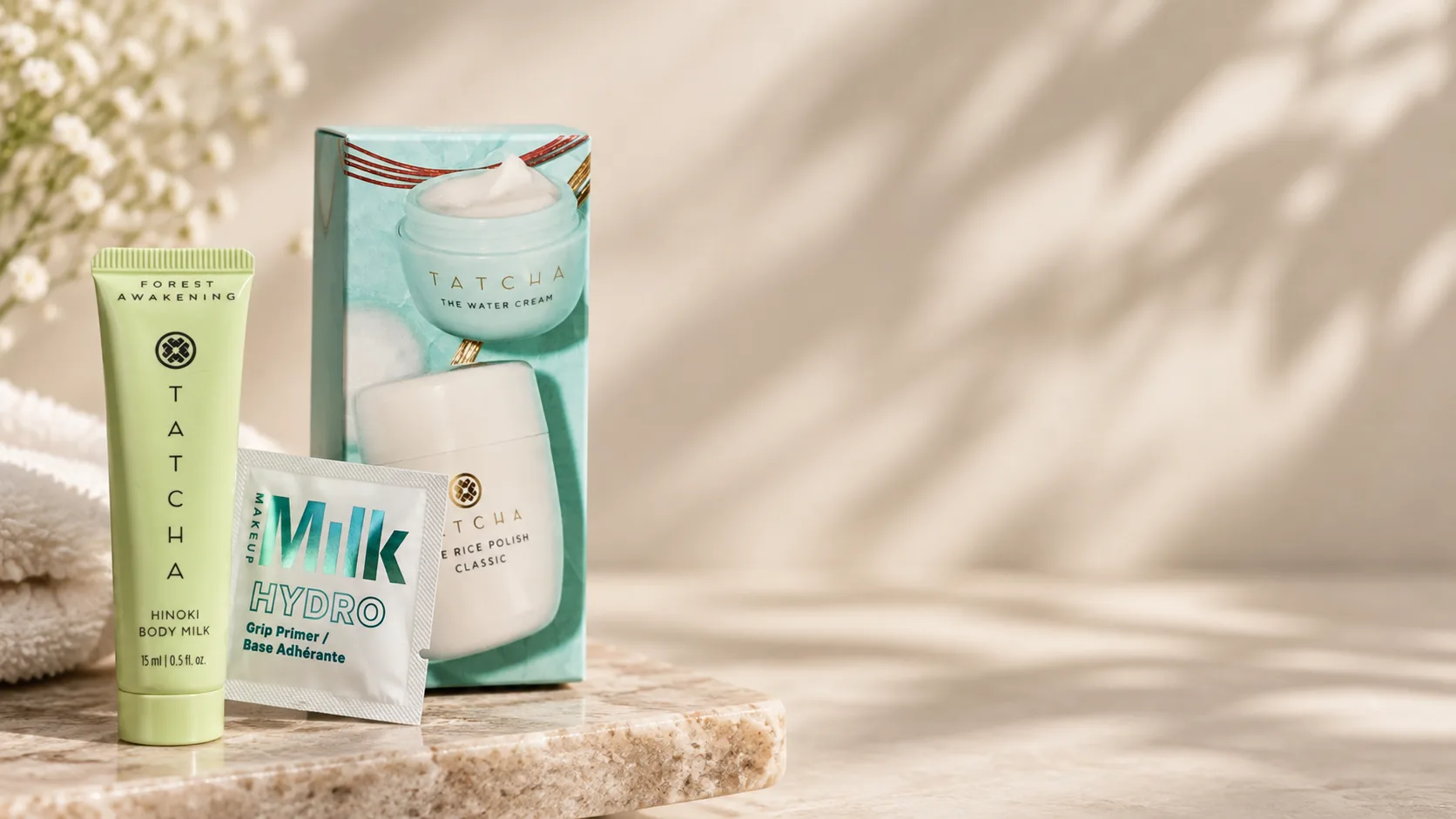
Some skincare brands are built around results. Others are built around the experience. Tatcha has carved out a very distinct space somewhere in between: products that are meant to perform, but are also genuinely enjoyable to use.
You can feel that intention in almost every detail. The textures, packaging, colors, fragrance, even the tiny gold spatulas that come with some of the creams - everything feels considered, and everything belongs to the same world.
But because Tatcha is so good at making you want its products, I’m even more interested in looking past the beautiful jars and asking what’s actually inside.
Which products are truly good? Who are they best suited for? And when does the luxury experience actually justify the price?
Because at Tatcha prices, feeling nice on the skin isn’t enough for me.
The story behind Tatcha
Tatcha was founded by Vicky Tsai after a period in which she was working in a demanding corporate career while dealing with significant skin issues of her own.
A trip to Kyoto became a turning point. There, she encountered Japanese beauty rituals and philosophies that approached skincare less as a list of problems to fix and more as an act of care.
That experience helped shape one of the ideas that still runs through Tatcha today: skincare doesn’t have to feel like another task to get through. It can be a few minutes in your day that you actually look forward to.
But Tatcha wasn’t built by Tsai alone.
The founding team brought together scientific expertise and a deep understanding of Japanese culture. Tokyo-born Nami Onodera helped establish relationships with Japanese artisans, scholars, and cultural experts. Chemist Masato Tagawa became central to the scientific side of the brand and developed Tatcha’s Hadasei-3 complex. Shuichi Tanaka, an expert in Japanese beauty culture and business, helped shape the brand’s approach to products, packaging, and the customer experience.
That may help explain why Tatcha feels so cohesive.
The formulas, packaging, rituals, and language don’t feel like separate pieces assembled after the fact. They all tell the same story.
Hadasei-3: at the heart of Tatcha
One thing you’ll see throughout the line is Hadasei-3, Tatcha’s proprietary complex.
It combines Akita rice, Uji green tea, and Okinawa algae through a double-fermentation process. According to Tatcha, the complex was developed with scientists at the Tatcha Institute in Tokyo and is designed to support hydration, the skin barrier, and healthy-looking skin.
It sounds compelling. But this is where I think it’s important to separate the story from the formula.
I like knowing why certain ingredients were chosen and understanding the thinking behind a product. But a beautiful story about Japanese tradition or fermented ingredients doesn’t automatically make a skincare product exceptional.
At the end of the day, your skin doesn’t experience the brand story. It experiences the finished formula.
So when I look at a Tatcha product, I’m interested in the ingredients, the texture, who it’s best suited for, what it actually adds to a skincare routine - and at these prices, whether it’s worth the money.
The story may get me interested in the product. The product still has to earn the recommendation.
Three moisturizers, three very different needs
Once you start looking more closely at Tatcha’s moisturizers, it becomes obvious that there really isn’t one definitive “Tatcha cream.”
The Dewy Skin Cream, The Water Cream, and Indigo Overnight Repair are very different products. I wouldn’t choose between them based on which one gets the most attention. I’d choose based on your skin and what you actually need from a moisturizer.
The Dewy Skin Cream
This is probably the product most closely associated with Tatcha, and I completely understand the appeal.
It’s a rich moisturizer designed to deliver plenty of hydration and leave skin looking soft, plump, and dewy. If you have dry skin and love a luminous finish, this is the Tatcha moisturizer I’d look at first.
I can also see its appeal from a makeup perspective. When I’m working with dry skin and want foundation to look fresh rather than sit dry on the surface, skin prep can make an enormous difference. A moisturizer that gives the skin plenty of hydration and leaves it supple and luminous can work beautifully here.
The formula includes glycerin and squalane, two ingredients I’m happy to see when I’m looking for hydration and softness.
But I do have a caveat.
The formula contains fragrance as well as Myristyl Myristate. That doesn’t mean the cream will cause problems for everyone, but if your skin is very sensitive, prone to clogged pores, or simply tends to react easily, I wouldn’t ignore it.
For dry, non-sensitive skin, though, I can absolutely see why The Dewy Skin Cream became one of Tatcha’s defining products. It delivers exactly the experience the brand promises: rich hydration, a beautiful skin feel, and a luminous finish.
My take: for the right skin, it could be a beautiful choice. For sensitive or highly reactive skin, I’d be more cautious rather than buying it based on the hype alone.
The Water Cream
If The Dewy Skin Cream sounds like too much for your skin, The Water Cream is where I’d look next.
The texture is completely different. It’s much lighter, watery, almost gel-like, and makes more sense to me for combination or oily skin - or simply for anyone who doesn’t like the feel of a rich moisturizer.
It absorbs quickly and gives you hydration without the more enveloping feel of The Dewy Skin Cream.
Texture-wise, I can understand why it sometimes gets compared with gel moisturizers like Neutrogena Hydro Boost. I’d take that comparison as a way to understand the type of texture, not as a suggestion that the formulas are the same.
If I were choosing a starting point between the two, it would be pretty straightforward: for dry skin, I’d start with The Dewy Skin Cream; for combination or oily skin, The Water Cream.
From there, of course, your skin gets the final say.
Indigo Overnight Repair
Indigo Overnight Repair serves a different purpose altogether.
This is a richer, thicker nighttime moisturizer that interests me most for dry skin or when the skin barrier needs more support.
The formula contains ceramides, which are exactly the kind of ingredients I want to see in a product designed to support the skin barrier and help maintain moisture.
So I don’t really compare this one with The Water Cream. They aren’t trying to do the same job.
The Water Cream makes sense when you want lightweight hydration. Indigo Overnight Repair is the kind of product I’d reach for at night when skin feels dry and needs something richer and more comforting.
The Rice Wash
Interestingly, Tatcha’s cleanser is one of the products in the line that really catches my attention.
The Rice Wash is a gentle cream cleanser, and it carries through the same philosophy you see across the brand: even cleansing, arguably the most functional part of a routine, should feel good.
That matters to me.
A good cleanser shouldn’t leave my skin feeling tight and dry. I want my skin to feel clean, but still comfortable and soft after I rinse.
That’s what The Rice Wash is going for. The texture is creamy and soft, and you only need a small amount each time.
With an expensive cleanser, that matters. The price of the tube is only part of the equation. I also want to know how much I need per use and how long the product is realistically going to last.
Still, it is a cleanser. At Tatcha prices, I want to feel that it gives my skin something I can’t easily get from a significantly less expensive option.
A beautiful cleansing experience alone isn’t enough for me.
The Essence
The Essence may be the product that most directly represents Tatcha’s approach to skincare.
It’s centered around Hadasei-3 - rice, algae, and green tea - and is designed to go on after cleansing, before your serums and moisturizer.
I think of it primarily as another lightweight layer of hydration at the beginning of a routine.
And this is where I always ask the same question: do I actually need another step?
If my routine is already giving my skin enough hydration, an additional product needs to give me a good reason to add it. On the other hand, if I prefer building hydration through several light layers instead of relying on one rich moisturizer, I can absolutely see where an essence fits.
This isn’t something I’d buy simply because it “completes the ritual.” At this price, it needs to earn its place in the routine.
The Kissu Lip Mask
The Kissu Lip Mask is exactly the kind of product that’s easy to want.
It has a rich, glossy texture and is designed to leave lips feeling deeply moisturized, soft, and nourished.
But with a product like this, I don’t look only at the price of the jar. I also look at how much you actually use each time.
You need very little product with a lip mask, so a small jar can last much longer than you might expect. To me, that changes the value equation.
It still doesn’t make a luxury lip mask essential. But if it performs well, requires very little per use, and lasts for months, that’s a different conversation from an expensive product you go through quickly.
Luminous Dewy Skin Mist
As a makeup artist, this is one of the Tatcha products I look at a little differently.
A hydrating mist isn’t interesting to me only as skincare. I want to know what it does over makeup.
Sometimes makeup looks beautiful when you finish it, but a few hours later the skin starts to feel a little tight or the finish begins to look drier. A good mist can bring some comfort back to the skin and soften the overall look of the makeup.
In that sense, “hydration in a bottle” is a pretty good description of what this product is trying to do.
But my real test isn’t simply whether it feels refreshing. I want to know how it behaves over foundation: Does it soften the finish without disturbing the base? Does it add a beautiful glow without making the skin look overly wet? And is the difference significant enough to justify the price?
Forest Awakening Hinoki Body Milk
The Forest Awakening Hinoki Body Milk takes Tatcha’s approach beyond facial skincare and into body care. It’s a lightweight body moisturizer built around hinoki, the Japanese cypress that gives the Forest Awakening collection its distinctive woody scent.
What interests me here is the texture. Body moisturizers can become a product you avoid using simply because they feel too heavy or take too long to absorb. A body milk makes much more sense when you want hydration without that rich, coated feeling - especially for daytime or warmer weather.
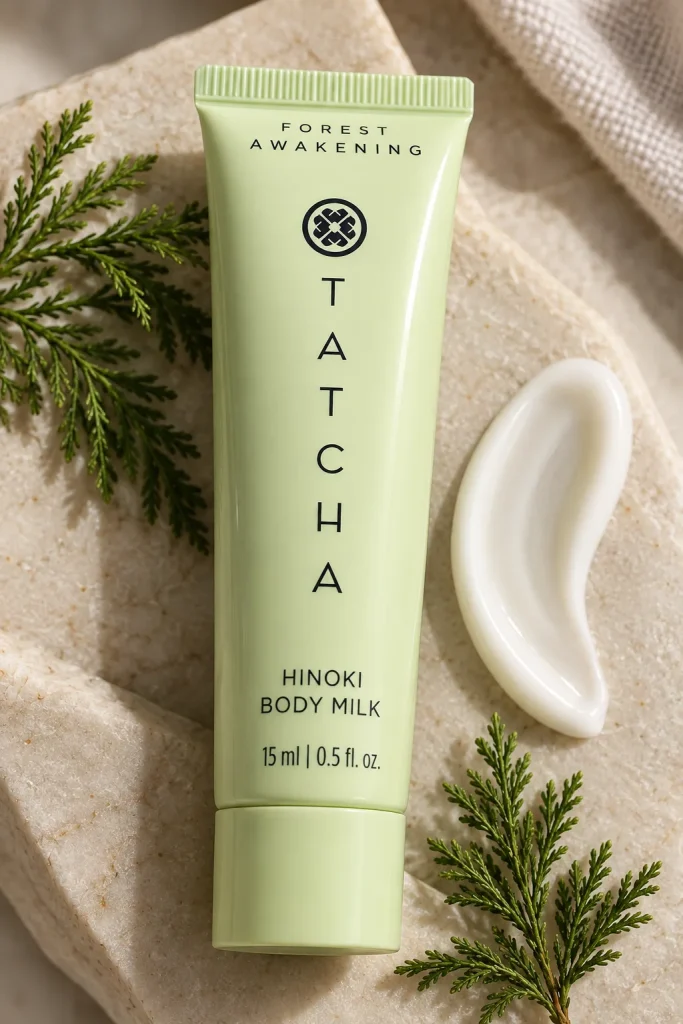
The hinoki scent is also a big part of the experience, so I wouldn’t treat this as a purely functional moisturizer. This is very much Tatcha doing what Tatcha does best: turning an everyday step into something that feels more considered and enjoyable.
But the same rule applies here as it does to the face products: the sensory experience is part of the value, not a substitute for performance.
What about sensitive skin?
This is where I don’t let Tatcha’s soft, soothing aesthetic make the decision for me.
The colors, textures, and whole idea of skincare as ritual can make the brand feel inherently gentle. That doesn’t mean every formula is automatically a great choice for sensitive skin.
Some Tatcha products contain fragrance, and there are formulas where I’d look carefully at the ingredient list before recommending them to someone whose skin reacts easily.
And “sensitive skin” isn’t one universal condition. A product that works beautifully for one person can leave someone else dealing with redness, discomfort, or breakouts.
That’s why, especially at Tatcha prices, I like the idea of trying a sample or mini first whenever possible.
So what are you actually paying for with Tatcha?
This may be the most interesting question about the brand.
You can find glycerin, squalane, ceramides, and other hydrating ingredients in products that cost considerably less. If you judge Tatcha only by an ingredient list and price per ounce, it won’t always be the obvious choice.
But I also don’t think skincare should be judged by an ingredient list alone.
The finished formula matters. Texture matters. How the product sits on the skin matters. And the fact that I enjoy using something enough to reach for it every day isn’t meaningless either.
This is where Tatcha is particularly strong.
It knows how to make products feel luxurious and considered, and the experience doesn’t feel like something added after the formula was finished. It feels like part of the product itself.
I give that value.
I just don’t let it replace the more important question: Is the product itself good enough for me to recommend it?
Skincare that’s also an experience
Tatcha talks extensively about the connection between skin and mind, and the idea that skincare can be more than a series of steps we complete morning and night.
One concept the brand references is hinou-dokon, a Japanese idea it describes in terms of skin and mind sharing the same root. In recent years, Tatcha has also talked about what it calls NeuroSkin Science and the relationship between skin, the nervous system, stress, and well-being.
I don’t think you need to get deep into that philosophy to understand what Tatcha is trying to do.
Just open one of the products.
There’s an enormous amount of attention paid to texture, scent, packaging, and how the product feels while you’re using it. Tatcha doesn’t want skincare to feel clinical or purely functional. It wants you to enjoy it.
And that’s a meaningful part of the brand’s appeal.
More than the purple jar
It’s easy to reduce Tatcha to what photographs beautifully: the purple jar, turquoise and gold packaging, tiny spatulas, and creams that leave the skin looking luminous.
But the deeper you get into the brand, the clearer it becomes that its strength is in how all of those pieces work together.
The Japanese inspiration, formulas, textures, packaging, and the idea of skincare as ritual all belong to the same world.
Tatcha also maintains a partnership with Room to Read, an organization whose work includes supporting girls’ education and literacy.
It all adds up to an unusually cohesive brand story.
But for me, a great story never gives the products inside it a free pass.
So, what do I think of Tatcha?
The more closely I look at the brand and its products, the more I think Tatcha’s strength isn’t one miracle ingredient.
It’s the combination of formula, texture, and experience.
Tatcha knows how to make products you want to use. The packaging is beautiful, the textures are carefully considered, and many of the products deliver exactly the kind of indulgent experience the brand promises.
I do think that has value.
A skincare product you genuinely enjoy using is also one you’re more likely to use consistently.
But I don’t let the experience replace an evaluation of the formula.
With Tatcha in particular, I want to understand who each product is actually for. The Dewy Skin Cream can make a lot of sense for dry, non-sensitive skin, but it wouldn’t be my first choice for skin that reacts easily. The Water Cream makes more sense when you want something lightweight. Indigo Overnight Repair serves a different purpose when skin needs something richer and more supportive.
And products like The Essence, The Kissu Lip Mask, and the Luminous Dewy Skin Mist have another hurdle to clear for me: it isn’t enough for them to feel good. They need to add enough to a routine to justify another product at Tatcha prices.
Ultimately, that’s my test for any luxury skincare brand:
Once you take away the packaging, the scent, and the experience, is there still a product I genuinely want to recommend?
Tatcha on LOREN STANDARD
Here you’ll find our Tatcha reviews, guides, comparisons, and editorial coverage. As we evaluate more of the line, this page will continue to grow.
Every product gets evaluated on its own. One excellent product doesn’t automatically earn an entire brand our recommendation, and one product that doesn’t work for a particular skin type doesn’t invalidate everything else in the line.
Because even with one of the prettiest jars in skincare, our rule stays the same:
We love products. Not logos.


