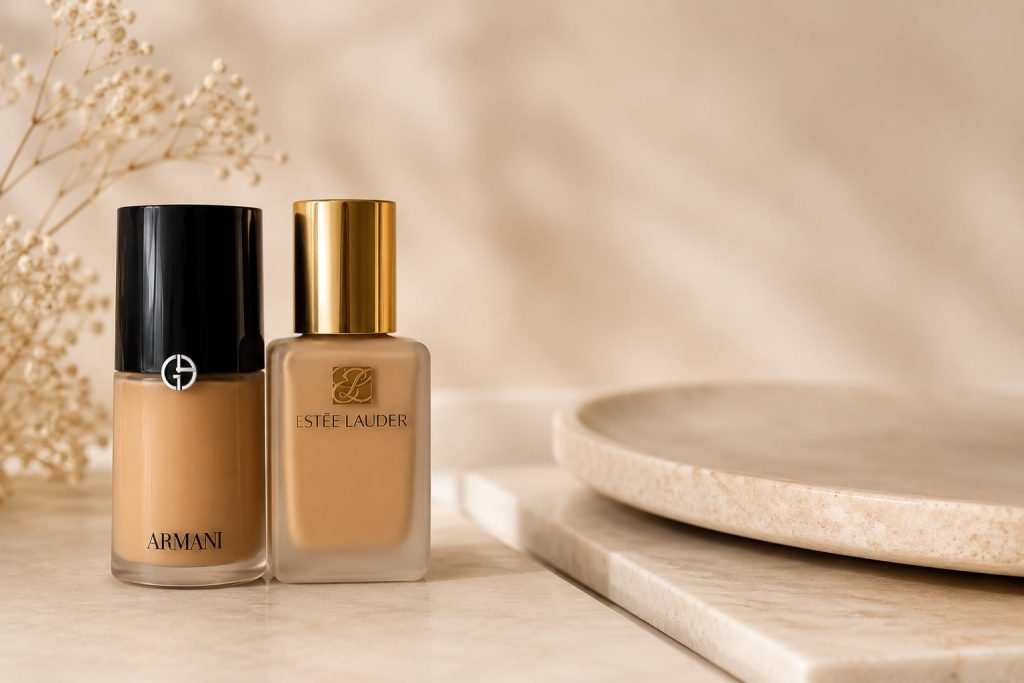
The best foundation isn’t simply the one that matches your skin tone. Start with the formula: your skin type, the coverage you want, the finish you love and how you need the foundation to perform. Once you know that, finding the right shade becomes much easier.
Why choosing foundation feels so complicated
Most of us know the moment.
You walk into a beauty store and stand in front of dozens of bottles that look more or less identical, each one promising something different.
Natural finish. Full coverage. Glow. Matte. 24-hour wear. Hydrating. Skin-like.
What should have been a simple purchase suddenly turns into a research project.
And most people begin in exactly the same place:
What’s my shade?
Shade matters, obviously.
But shade matching comes later than most people think.
Before I start looking at numbers and undertones, I want to know something much more fundamental:
What do I actually want this foundation to do?
Don’t start with the shade
Imagine finding the perfect shade match in a foundation you hate wearing.
Maybe it’s too matte for you. Maybe you wanted your freckles to remain visible and it covers everything. Maybe your skin is dry and the formula emphasizes every patch. Maybe you wanted something almost imperceptible and ended up with a foundation designed primarily around coverage and wear.
The color can be perfect.
The foundation is still wrong.
So before I look for the shade, I think about the finished skin.
Do you want your skin to look almost bare?
Do you want to soften redness while keeping freckles visible?
Do you need to cover pigmentation?
Do you want glow?
Do you prefer a more controlled, matte finish?
Do you need the makeup to last through a very long day?
Those answers tell you which kind of foundation you should be shopping for.
Then we find your color within that formula.
First, choose the formula
This is the principle behind the way I shop for foundation professionally and personally.
Don’t fall in love with a shade. Fall in love with the formula first.
Once I find a formula that behaves beautifully on the skin, gives me the finish I want and suits the way I need to use it, shade matching becomes a much more straightforward problem.
And there are far more differences between foundation formulas than the bottles on a beauty counter suggest.
Coverage and wear are not the same thing
One of the easiest mistakes to make is assuming that foundation runs along a simple spectrum:
Sheer means lightweight and short-wearing. Full coverage means heavier and longer-wearing.
Real formulas are much more complicated than that.
Coverage and longevity are two different things.
Coverage describes how much of the skin the formula visually corrects or conceals.
Wear describes how well the result holds over time.
A foundation can be relatively sheer and still be designed to wear extremely well. Another can give substantial coverage while remaining creamy and flexible.
The same applies to texture.
More coverage does not automatically have to mean a thick, mask-like result.
Application makes an enormous difference.
So when I compare foundations, I think about several things separately:
- Coverage.
- Finish.
- Texture.
- Buildability.
- Wear.
- How the formula behaves on the skin.
That gives me a much more useful picture than simply calling a foundation “light” or “heavy.”
Understanding the foundation spectrum
Skin tint
Skin tints sit at the lightest end of the complexion category.
Skin Tint, Skin Veil, Complexion Tint, Tinted Moisturizer - brands use different names, and the categories overlap considerably.
The basic idea is similar.
These formulas aren’t designed to make the skin disappear beneath makeup. They lightly even the complexion while allowing much more of the natural skin to remain visible.
Freckles may still show. Pigmentation may still be visible.
The point is not complete correction.
The point is better-looking skin that still very obviously looks like skin.
If that’s what you love, don’t let anyone convince you that you need more coverage simply because more coverage exists.
BB cream and CC cream
BB and CC creams once had clearer distinctions than they do now.
BB creams were generally positioned as hybrid complexion products combining skincare, light coverage and often sun protection.
CC creams focused more heavily on color correction.
Today, those labels tell you much less.
One brand’s CC cream can offer more coverage than another brand’s foundation. A BB cream can feel like a skin tint. A product with “CC” on the tube may have a completely different finish from another one carrying exactly the same label.
So I wouldn’t choose one because it says BB or CC.
Look at what the individual formula actually does.
Natural-finish foundation
This is one of the most versatile foundation categories.
A good natural-finish foundation sits somewhere between barely-there complexion products and formulas built primarily around maximum coverage or an obviously matte or dewy effect.
It evens the complexion without making the skin look completely covered.
Depending on the formula and how much you use, natural variation in the skin can remain visible while redness and uneven tone become less noticeable.
Armani Luminous Silk - one of my reference points
Armani Beauty Luminous Silk Foundation is one of the foundations I immediately think of in this category - and one I’ve worked with professionally for years.
There’s a reason Armani Luminous Silk has become such a recognizable foundation.
What I value about it isn’t simply luminosity.
It’s control.
I can use a relatively small amount and keep the complexion looking very natural, then build coverage selectively where the skin needs more.
That matters to me as a makeup artist because I don’t necessarily want a foundation to decide how much coverage the finished face has.
I want the formula to give me room to decide.
And that’s one of the qualities I look for in foundation generally.
A good formula doesn’t force me into one result.
It gives me options.
Dewy and luminous foundation
If you love skin that looks alive, radiant and hydrated, this is where you’ll naturally gravitate.
But “luminous” and “dewy” aren’t interchangeable with greasy, and they don’t automatically mean poor wear.
Modern luminous foundations can create light on the skin without making the entire face look wet.
And a radiant finish doesn’t necessarily mean the foundation will disappear after a few hours.
Again, formula matters.
On normal or dry skin, luminous foundations can be particularly beautiful because they don’t fight the skin’s natural texture.
But oily skin doesn’t automatically rule them out either.
You can control shine selectively rather than mattifying the entire face.
That distinction is important:
Glow where you want it and oil where you don’t are not the same thing.
Medium-to-full coverage foundation
Higher coverage makes sense when you want more correction from the foundation itself.
That might mean redness, pigmentation, blemishes or simply a preference for a more perfected complexion.
But I still don’t want to see a thick layer sitting on the skin.
I would much rather work in thin layers.
Start with less. Blend it properly. Then add coverage exactly where it’s needed.
That approach is particularly important in professional makeup.
The goal isn’t to prove how much the foundation can cover.
The goal is to create the skin I want with as little product as I need to get there.
Long-wear foundation
Long-wear is a performance category, not a coverage level.
That distinction matters.
Some long-wear foundations give substantial coverage. Others don’t.
What they share is that they’re designed to hold up better through extended wear and conditions that challenge makeup.
Heat. Humidity. Oil. Movement. A very long day.
This is obviously important in bridal makeup, but it can matter just as much for someone who puts on foundation at seven in the morning and needs it to look good after work.
With these formulas, I pay particular attention to application.
More product doesn’t necessarily give you more longevity.
In fact, piling on too much can work against you.
Thin, controlled layers are usually my preference.
Liquid, stick or powder?
Coverage isn’t the only decision.
Texture changes the way you work with foundation too.
Liquid foundation
Liquid is the format I find most flexible.
It’s easy to apply in thin layers, easy to build, and particularly useful professionally because I can mix shades and control exactly where I want more coverage.
That versatility is one reason liquid foundation dominates so much of both the consumer and professional market.
Stick foundation
Stick foundation is convenient, portable and often gives you a lot of pigment quickly.
It can be excellent for targeted application as well as full-face coverage.
But formulas vary enormously.
Some remain creamy for quite a while. Others set quickly and need to be blended almost immediately.
So again, I wouldn’t assume that the format tells you everything about the performance.
Powder foundation
Powder foundation can be very useful if you like a faster application or a more controlled finish.
But I’m cautious about blanket rules like “powder is for oily skin.”
Skin preparation, formula and application all matter.
And on dry or textured skin, too much powder can make texture considerably more visible.
No foundation texture is inherently better.
The question is what works on your skin and gives you the result you actually like.
Higher coverage isn’t automatically better
This is one of the most common foundation mistakes I see.
People often assume that if a foundation covers more, they’re somehow getting more product for their money.
But coverage isn’t a quality score.
If you love seeing your freckles, why buy a foundation whose greatest strength is hiding them?
If your skin is already relatively even and you love a barely-there complexion, a skin tint may give you a much more beautiful result than an opaque foundation.
And if you have significant discoloration you want to conceal, the opposite may be true.
The right foundation isn’t the one that hides the most.
It’s the one that makes your skin look the way you want your skin to look.
Michal’s tip: Before I choose a foundation, I don’t ask, “How much does it cover?” I ask, “How do I want this skin to look when I’m finished?” Coverage is a tool for getting there. It isn’t the goal by itself.
How to choose foundation for your skin type
Skin type matters.
But I don’t believe in turning it into a rigid formula where dry skin is allowed one type of foundation and oily skin another.
Think of it as information.
Dry skin
If your skin is dry, tight or flaky, I generally look toward flexible formulas with natural or luminous finishes.
But preparation matters enormously.
Foundation cannot completely compensate for dehydrated, flaky skin underneath it.
Give skincare time to settle before foundation goes on, and don’t assume adding more makeup will solve visible texture.
Often it does the opposite.
Normal skin
Normal skin gives you the greatest flexibility.
Rather than solving an oil or dryness problem, you can focus primarily on the finish you actually like.
Matte. Natural. Luminous. Sheer. Fuller coverage.
This is where preference gets to drive much more of the decision.
Combination skin
Combination skin is a perfect example of why I don’t like one-size-fits-all foundation rules.
If your T-zone gets oily but your cheeks are normal or dry, you don’t necessarily need to put a very matte foundation over your entire face.
I often prefer controlling shine where the shine actually happens.
That can mean selective powdering rather than forcing the whole complexion into the same finish.
Oily skin
Oily skin does not automatically mean you need the driest, most matte foundation you can find.
A formula that holds up well against oil is useful.
A formula that makes your skin look flat and uncomfortable simply because the label says “matte” is not necessarily useful.
Skin prep matters here too.
So does the amount of foundation you apply.
And strategic powdering can often do more for the finished result than choosing an aggressively matte formula.
Mature skin
With mature skin, I pay particular attention to how much product I’m using.
More coverage isn’t automatically more flattering.
In fact, thick layers can emphasize lines and texture that a thinner application would leave much less noticeable.
I generally prefer formulas I can build gradually.
Start thin. Correct only where necessary. Let the areas of beautiful skin remain skin.
Does water-based vs. silicone-based foundation really matter?
This has become one of the most discussed topics in professional makeup.
You may have seen videos where a makeup artist pours water over a finished face, presses a tissue against it, and almost nothing moves.
There are professional techniques built around carefully layering products for extreme longevity, and silicone-heavy formulas are often part of those systems.
I’ve studied techniques like these myself in professional training.
There are useful ideas to take from them, particularly when extreme wear is the goal.
But I don’t think the takeaway should be:
“All of your products must have the same base or your makeup will fail.”
Cosmetic formulations are more complicated than dividing every product into a simple water-versus-silicone category.
Compatibility depends on the complete formulas, how much product you use, how the layers set, skincare underneath, application technique and the skin itself.
And for many of my brides, extreme longevity isn’t the only goal.
They also want skin that looks natural, alive and luminous.
I’m interested in finding the balance between the two.
Makeup has to last. But I still want it to look like beautiful skin.
Now we can talk about shade
Once you’ve narrowed down the formula, it’s time to find your color.
There are two main things to think about: depth and undertone.
Depth is essentially how light or deep the shade is.
Undertone describes the color direction underneath it.
You’ll commonly see foundation shades described as:
- Cool.
- Neutral.
- Warm.
- Olive.
But there’s an important catch.
There is no universal foundation shade system.
Don’t assume every brand speaks the same shade language
This causes an enormous amount of confusion.
You learn that you’re a certain letter or number in one foundation and assume you can translate that directly into another brand.
You usually can’t.
Dior has its own shade and undertone system. Estée Lauder has its own. MAC’s historic NC and NW terminology has confused generations of shoppers who expect the letters to work intuitively. Armani Beauty has its own numbering system too.
So knowing your shade in one brand is useful information.
It is not a universal foundation passport.
When you move to another formula, start again with that brand’s shade range.
How I choose foundation when I’m ordering online
I buy plenty of makeup without trying it first.
But I don’t buy it blind.
This is the process I use.
Step one: understand the brand’s shade system
First I work out how that specific brand organizes shades and undertones.
What does warm mean to them? What does neutral mean? Do they identify olive separately? Which shades sit at approximately the depth I need?
That immediately narrows the search.
Step two: search for real swatches
Then I search the product name plus “swatches.”
For example: Armani Luminous Silk swatches. Or: Dior Forever Skin Glow swatches.
And I never rely on one image.
Lighting changes color. Cameras change color. Editing changes color. Screens change color.
I want to see the same foundation on several people and in several lighting conditions.
Step three: look for the exact shade on video
Once I think I’ve found the right shade, I search the product name and shade number on TikTok or other video platforms.
This can be extremely useful.
If I can find someone whose complexion looks reasonably close to mine applying the actual shade to her face, I learn much more than I can from a tiny digital swatch on a retailer’s website.
I’ve used this method for years, and it has saved me from plenty of bad online orders.
It isn’t foolproof.
But it’s much better than guessing from the bottle.
Match foundation to your face - not your hand
The back of your hand is convenient.
It is not necessarily the same color as your face, neck or chest.
When I’m assessing a foundation match, I care about how the face connects visually with the areas around it.
The goal isn’t to make one square centimeter of skin disappear perfectly into a hand swatch.
It’s to make the finished complexion look coherent.
And don’t use a darker foundation because you want to look tanned.
That’s what bronzer and other complexion products are for.
Foundation should create the base.
You can add warmth and dimension afterwards.
Does foundation oxidize?
Sometimes a foundation appears to deepen or shift after application.
People often describe every change like this as “oxidation,” although several things can influence the way a foundation looks once it has settled on the skin.
The practical advice is simpler:
Don’t make your final shade decision the second you apply it.
Let the foundation sit. Look at it again after it has settled.
And, whenever possible, check it in natural daylight.
Store lighting is not your friend when you’re trying to judge foundation color.
The most common foundation mistakes I see
- Choosing the shade before deciding whether you actually like the formula.
- Matching foundation only on the back of your hand.
- Choosing a darker foundation because you want to look more tanned.
- Assuming more coverage means a better foundation.
- Assuming oily skin must wear matte foundation.
- Assuming dry skin can never wear powder.
- Applying more product because you want it to last longer.
- Judging a shade only under store lighting.
- Ignoring how the foundation looks after it settles.
- Buying a product simply because it went viral.
Most of these mistakes come from the same place:
Treating foundation like a color instead of a formula.
Michal’s tip: Don’t fall in love with a shade. Fall in love with the formula. Once you’ve found a foundation that makes your skin look the way you want it to look, finding the right shade is the solvable part. A perfect shade in a formula you hate is still the wrong foundation.
So what foundation should you actually choose?
Start with the result rather than the product.
If you want almost-bare skin
Start with skin tints and other sheer complexion formulas.
Let freckles and natural skin variation remain visible.
If you want natural everyday coverage
Look for a buildable natural-finish foundation.
This is where formulas such as Armani Luminous Silk make sense to me: enough pigment to refine the complexion, but enough flexibility to control how finished you want the skin to look.
If your priority is glow
Look at luminous and dewy formulas, but judge them by how they behave after several hours - not only by how beautiful they look five minutes after application.
If you want more correction
Move toward medium-to-full coverage formulas, but still build in thin layers.
You may not need the same amount of coverage over the entire face.
If longevity is the priority
Shop specifically for long-wear performance rather than assuming the fullest-coverage foundation will automatically last longest.
And remember that preparation and application are part of longevity too.
The bottom line
The right foundation starts long before you reach the shade chart.
First decide what you want your skin to look like.
Do you want freckles to show through? Do you want more correction? Do you love glow, or do you prefer a more controlled finish? How long does the makeup need to last? How does your skin actually behave during the day?
Those answers narrow a wall of foundations down much faster than a shade number ever will.
Then comes color: depth, undertone and the way the actual formula settles on your skin.
I’ve worked professionally with everything from barely-there complexion products to high-coverage camouflage, and I still come back to the same principle:
Don’t fall in love with a shade. Fall in love with the formula first.
Because once you find a foundation that makes your skin look the way you want it to look, finding the right shade becomes the easier part.
Frequently asked questions about choosing foundation
How do I choose foundation for the first time?
Start by deciding what you want the finished skin to look like.
Choose your coverage level and finish, consider your skin type and how long you need the makeup to wear, and then shade-match within the formulas that meet those needs.
What foundation is best for dry skin?
There isn’t one universal answer, but I usually look toward flexible, natural or luminous formulas and pay particular attention to skincare underneath them.
The best foundation in the world will struggle over visibly dehydrated, flaky skin.
What foundation is best for oily skin?
Look for a formula that holds up well on your skin rather than automatically choosing the most matte option available.
How you prepare the skin, how much foundation you use and where you powder can be just as important.
Does full-coverage foundation last longer?
Not necessarily.
Coverage and wear are different properties.
A foundation can offer relatively light coverage and excellent longevity, while another may be highly pigmented without being designed for maximum wear.
How do I know my foundation undertone?
Start with the shade system used by the specific brand.
Warm, cool, neutral and olive labels are useful, but brands don’t classify shades identically.
Whenever possible, compare several close shades on the face and allow them to settle before deciding.
Is Armani Luminous Silk good for natural-looking makeup?
It’s one of the foundations I’ve personally used for years when I want control over how perfected the complexion becomes.
What I particularly like about Armani Luminous Silk Foundation is that I can keep the application relatively natural and build more coverage selectively where I need it.
That flexibility is one of the reasons it has remained useful to me professionally.
Can I buy foundation online without trying it first?
Yes, but research helps enormously.
Learn the brand’s shade system, compare multiple swatches, then look for videos showing the exact shade on people with a complexion similar to yours.
I still prefer seeing a foundation on actual skin over relying on a digital shade square.
Should foundation match my face or my neck?
I’m looking for the finished face to connect naturally with the surrounding skin rather than following a rigid “always match this exact spot” rule.
Your face, neck and chest may not all be identical colors.
Look at the overall result.
Should I buy a darker foundation to look tanned?
No.
I prefer foundation to create a believable complexion match, then use bronzer and other complexion products to add warmth and dimension.
A foundation that is deliberately too dark can make the face look disconnected from the rest of the body.
Do I need primer under foundation?
Not automatically.
Primer is useful when it solves a specific problem or creates a result you want.
I don’t add a step simply because beauty marketing tells me every foundation requires one.
The combination of skincare, foundation and application technique may already give you exactly what you need.
Is expensive foundation better?
Not automatically.
Luxury pricing can reflect formulation, packaging, brand positioning and the experience surrounding the product.
I judge foundation by what happens on the face.
Does it give me the finish I want? Can I control the coverage? Does it behave well on the skin? Does it wear the way I need it to?
A luxury logo doesn’t answer any of those questions.
The formula does.


