
Anyone who has tried to choose a Kryolan Dermacolor Camouflage Creme shade knows that the system can be genuinely confusing.
Instead of a conventional shade range built around familiar names and undertone labels, you encounter codes: D NB2, D2W, D OB2, D ELO, D17, D5W and dozens more. If you don’t already know the range, very little about those codes tells you what will actually happen when the product reaches the skin.
I’ve worked with Dermacolor for years, and it remains one of the products I trust most in professional and bridal makeup. The reason isn’t simply coverage. It’s control.
I can use a tiny amount over another foundation where the skin needs more coverage, build it into a much fuller base, use color correctors beneath it, adjust a mixture’s undertone, or work with deeper shades for dimension.
And because the shades are designed to be mixed, I don’t need one perfect pan for every person who sits in my chair. I need a palette that lets me build the color I need.
That’s the idea behind this guide.
I’ll take you through the Dermacolor system, the shades and undertones I rely on in my own kit, how I mix them, and how I use the formula for everything from targeted coverage and discoloration to under-eyes and tattoos.
A note on shade terminology: Kryolan’s official shade codes don’t always translate neatly into the undertone language makeup artists use every day. Where I describe a Dermacolor shade as rosy, yellow, olive, or neutral, I’m describing how that shade reads and behaves in my own professional kit - not assigning it an official Kryolan undertone classification.
What is Kryolan Dermacolor?
Dermacolor Camouflage Creme is Kryolan’s highly pigmented cream camouflage makeup. The system is designed to correct and cover visible discoloration and irregularities, including tattoos, particularly on the face and neck.
One of the things that makes it especially useful professionally is that the shades are designed to be mixed. Kryolan specifically recommends combining one or more shades to achieve a closer skin match rather than assuming that one pan has to do everything.
The brand also recommends using very little product and building coverage in thin, stippled layers. With a formula this concentrated, that distinction matters: high coverage doesn’t have to mean a thick layer of makeup. Kryolan’s current application instructions follow exactly that small-amount, thin-layer approach.
Why Dermacolor earns its place in my bridal kit
Full coverage isn’t the only reason I pull it out.
When a bride wants a light or medium base, I can use a lighter-texture foundation across most of the face and bring Dermacolor in only where I want more coverage.
One breakout, one area of pigmentation, or one mark doesn’t mean the entire face needs another layer of heavy foundation.
When I do want significantly more coverage, I build Dermacolor gradually in thin layers rather than applying one heavy coat.
I also use shades from my Dermacolor palette for sculpting and dimension, and I work with the system around the eyes.
That versatility is why I don’t think of Dermacolor simply as “the makeup that covers everything.” In my kit, it’s a professional color system that I adapt to the skin and the job in front of me.
How to work with Dermacolor
Kryolan recommends beginning with clean, moisturized skin and using only a small amount of product.
One of the brand’s professional application recommendations is to work with the cream until it becomes more pliable before application. With highly pigmented cream products like this, getting the texture moving before you start building coverage makes a noticeable difference.
From there, I mix the shades I need and build the product gradually in thin, stippled layers.
Once you understand that approach, Dermacolor becomes much easier to control.
The shade system - and where everybody gets lost
This is the part that sends most makeup artists looking for a Dermacolor guide in the first place.
The range contains a huge number of codes: D NB, D NB2, D NB3, D NB4, D1W, D2W, D3W, D OB1, D OB2, D OB3, D ELO, D17, D18, D19, D12, D5W, and many more.
The most important thing to know before choosing one is this:
Don’t choose a Dermacolor shade from the code alone.
And don’t assume a letter in a Kryolan code necessarily means the same thing it would in another foundation system.
Kryolan itself cautions that the shades shown digitally may not be identical to the physical products, and that shade availability can vary between countries.
That’s one reason I rely on the actual pans in front of me rather than treating an online swatch or a code as definitive.
The rosy shades in my kit
When I need to move a complexion in a rosier direction, these are among the shades I reach for:
- D1W
- D2W
- D3W
- D NB2
- D NB3
I’m deliberately calling these the rosy shades in my kit, rather than saying Kryolan officially classifies all five as one rosy family.
They don’t simply become progressively darker as the numbers increase, either.
I choose according to the skin in front of me, and often the most precise match comes from mixing rather than using one pan straight.
How I read the NB shades
The NB shades are a good example of why I don’t like decoding Dermacolor by letters alone.
D NB
Despite sitting close to other shades I read as rosier, D NB itself has very little visible pinkness to my eye. In my kit it behaves much more like a natural beige, so I don’t treat it as a pink shade.
D NB2 and D NB3
These move much more clearly in the rosy direction in my work.
D NB4
This is a deeper shade within the NB group, and another reason I wouldn’t use the shortcut “NB = pink.”
The real pans are more nuanced than that.
The ELO shades in my working palette
When a complexion needs a more yellow direction, D ELO is one of the shades I find particularly useful.
It matters to me not only as a shade in its own right, but as a mixing tool.
If I’ve already reached the correct depth but the mixture isn’t yellow enough for the skin in front of me, I don’t necessarily start over with another base. I can adjust the color I already have.
That’s one of the biggest advantages of learning Dermacolor as a professional color system rather than a collection of individual concealer shades.
How I use the OB shades
The OB shades are the ones I turn to when I need more of an olive/yellow direction in my own working palette.
That can make an enormous difference on skin where a rosier mixture immediately looks disconnected from the complexion.
Again, this is my professional reading of the physical shades I work with rather than an attempt to turn Kryolan’s codes into an official universal undertone chart.
I look at three things: depth, undertone, and what the mixture actually does on the skin.
How I actually choose a Dermacolor shade
I start with the skin, not the number on the box.
Three questions matter:
- How deep is the skin tone?
- Which direction does the undertone lean?
- What is missing from the shade or mixture already on my palette?
From there, I either use an existing shade or mix two or more together.
For a makeup artist, learning to make those adjustments is far more useful than memorizing dozens of codes.
The undertone map I use in my own kit
This is my working map, based on the actual shades I use professionally. It isn’t an official Kryolan undertone chart.
| Shade / group | How it reads in my work | What I use it for |
|---|---|---|
| D1W | Rosy | Adding or matching a rosier direction |
| D2W | Rosy | One of the rosy shades I regularly use |
| D3W | Rosy | Another option within my rosy group |
| D NB | Natural beige | Very little visible pinkness in my experience |
| D NB2 | Rosy | Noticeably rosier than D NB |
| D NB3 | Rosy | Rosy |
| D NB4 | Deeper NB shade | I don’t automatically classify it as pink |
| D ELO | Yellow direction | Useful both alone and for adjusting mixtures |
| D OB shades | Olive/yellow direction | Useful when a rosier base looks wrong |
My base-shade palette
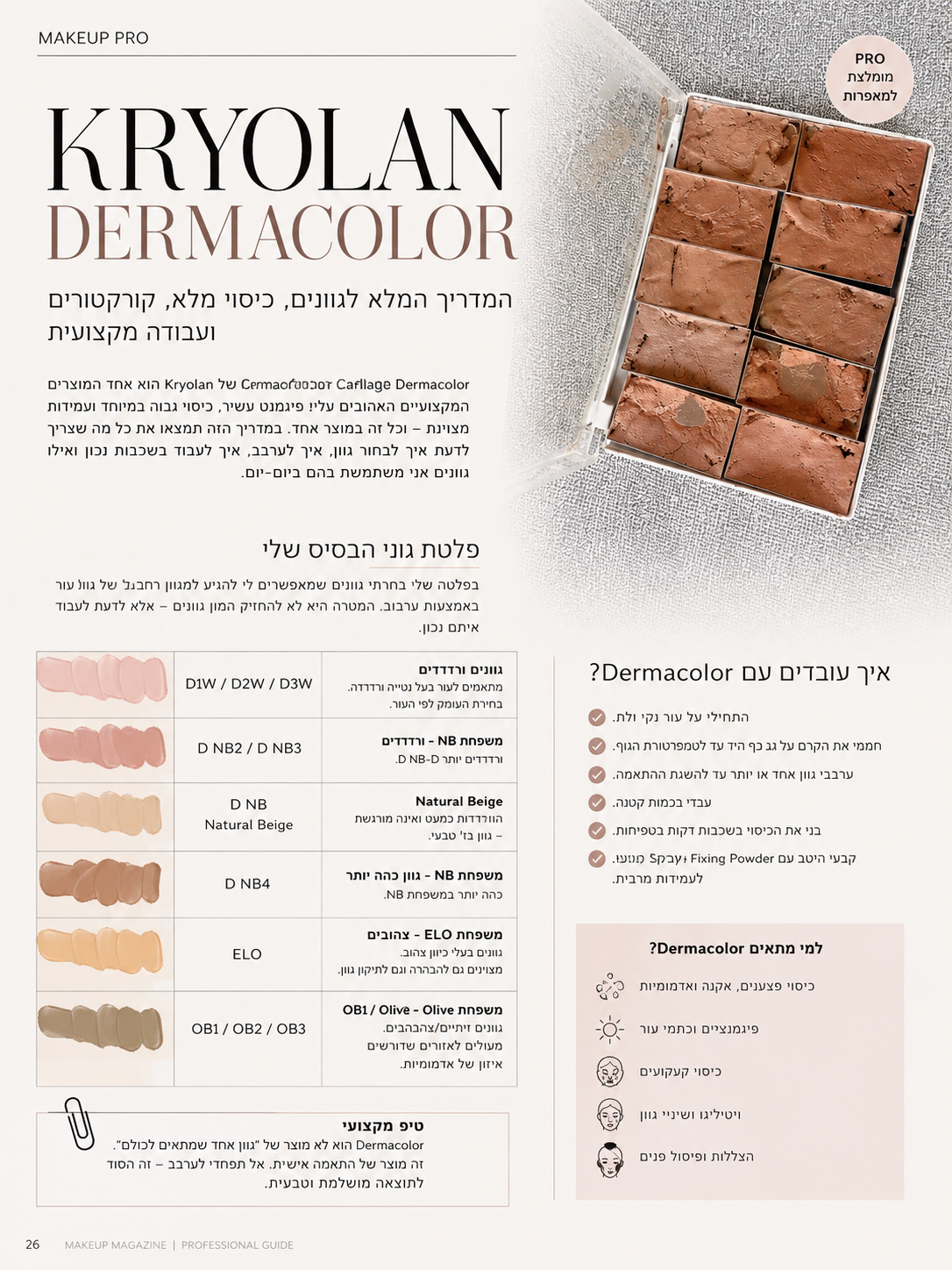
Rather than trying to own every shade Kryolan makes, I’ve built a palette that allows me to create a much wider range of matches through mixing.
That’s the principle I’d take from Dermacolor if I took nothing else from this guide:
The goal isn’t to own dozens of shades. The goal is to own shades that let you build what you’re missing.
That approach also makes sense within the system itself: Kryolan’s application instructions explicitly allow one or more Camouflage Creme shades to be mixed to create the closest possible skin match.
Building a professional palette
Dermacolor is available in formats that make it practical to build a customized working palette rather than buying a full-size product in every shade.
For a professional makeup artist, that matters. I’d rather have a carefully chosen range of depths, undertone directions, and correctors that I can mix than a large collection of nearly identical shades.
My shading and corrector palette
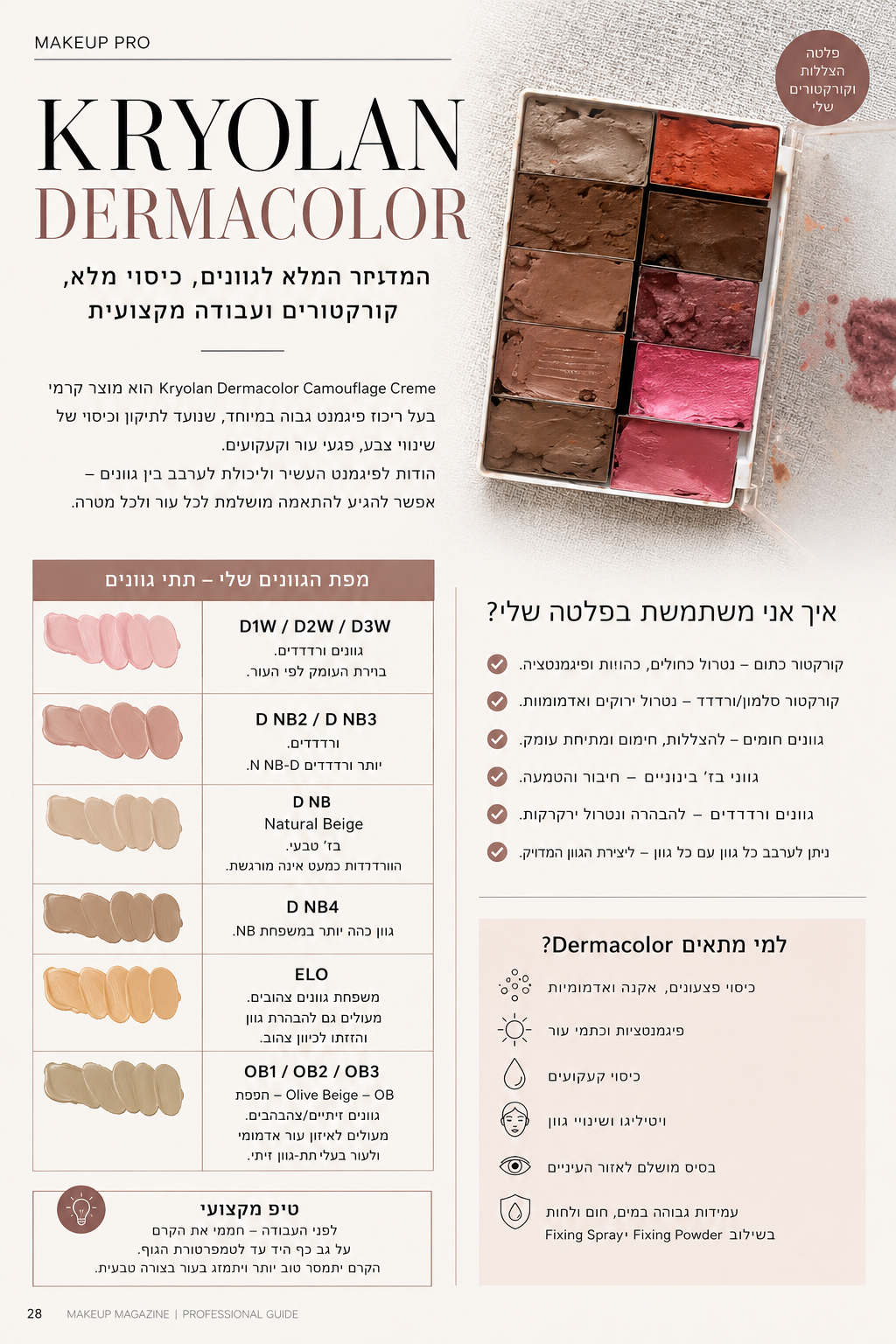
My second palette includes shades such as D17, D18, D19, D12, and D5W, along with the correctors I actually use.
I also keep an orange corrector and a rosy-salmon corrector.
I use some Dermacolor shades for sculpting and dimension, but there’s an important distinction here: that is how I use those shades in my own kit.
I wouldn’t tell you that D17, for example, is universally “the contour shade for skin type X” simply because of its number.
The skin decides.
Correctors: why color comes before coverage
Coverage and color correction are two different jobs.
Sometimes a skin-tone shade is enough to cover discoloration on its own.
Other times, the underlying color continues to show through even as you add more coverage. That’s where a corrector becomes useful.
The goal isn’t to paint an obvious orange, peach, or pink layer beneath the foundation.
I use just enough corrective color to change what is showing through, then build the skin-tone shade over it.
That usually gives me a much cleaner result than simply piling on more camouflage.
How I use Dermacolor under the eyes
Under-eye darkness is one of the areas where the correctors in my palette get a lot of use.
My technique is very controlled and layer-based.
I place a small amount of corrector where the darkness actually is rather than automatically covering the entire under-eye area. Depending on what the skin needs, I may then add another very thin layer of corrector or complexion color.
In my own technique, I sometimes set very thin corrective layers with Dermacolor Fixing Powder before adding the next.
I’ve found that this powder allows me to work in multiple fine layers without the result becoming as heavy or unstable as it can with some other powders.
That last point is my professional experience rather than a universal claim about every powder formula.
Dermacolor on breakouts
One of the most common mistakes I see with breakouts is increasing the coverage level across the entire face because of a few isolated areas.
I usually do the opposite.
I create the base I want across the skin, then bring Dermacolor in only where I genuinely need more pigment.
Because the formula is so concentrated, a small amount can make a substantial difference.
There is also an important limitation:
Makeup can disguise color. It cannot erase physical texture.
I can reduce the appearance of redness or discoloration, but a raised blemish is still raised and an indentation is still an indentation.
Adding more and more product in an attempt to eliminate texture can actually make that texture more noticeable.
Dermacolor on pigmentation and discoloration
This is where a highly pigmented camouflage product can be particularly useful.
Again, I build gradually.
Instead of adding a heavy layer across the entire face, I identify where the color differs from the surrounding skin and concentrate the additional coverage there.
If the underlying color needs neutralizing, I correct first.
Then I build the matching complexion shade until the transition between the area and the surrounding skin becomes much less noticeable.
What about vitiligo?
This requires an important product distinction.
Kryolan makes a separate product called Dermacolor Body Camouflage, designed for the body, arms, legs, and hands. The company specifically lists pigment loss and vitiligo among the discoloration concerns that Body Camouflage is designed to camouflage.
There is no single “Dermacolor shade for vitiligo.”
The objective is visual color matching, and that depends entirely on the individual complexion and the surrounding skin.
Two people with vitiligo may therefore require completely different shades or mixtures.
It’s also worth noting that Body Camouflage is a different formula with different application instructions: Kryolan describes it as self-setting and says it does not need to be powdered.
Dermacolor and tattoo coverage
Tattoo camouflage is one of the uses associated with the Dermacolor system.
But covering a tattoo isn’t always as simple as putting a skin-tone cream directly over the ink.
If the tattoo’s color continues to show through the complexion layer, I address that color first. Then I build the matching complexion shade over it gradually.
Thin layers matter.
Trying to achieve opacity with one extremely thick layer is rarely the route to the most convincing finish.
How to set Dermacolor
Setting is a major part of the Dermacolor system.
Kryolan’s current instructions recommend pressing Dermacolor Fixing Powder over Camouflage Creme once the desired coverage has been achieved, allowing it to set, removing the excess, and then finishing with Dermacolor Fixing Spray for maximum durability.
Kryolan describes the finished camouflage system as water-resistant and smudge-resistant. Its Fixing Powder is also specifically marketed to set, mattify, and waterproof Camouflage Creme.
The Fixing Spray provides additional protection after powdering; Kryolan says that once it dries, the camouflage becomes smudge-proof.
That durability is one reason Dermacolor has earned a permanent place in my bridal kit. Properly applied and set, it gives me a highly durable camouflage layer exactly where I need one - particularly useful during long wedding days.
Light, medium, or full coverage?
Dermacolor has a reputation for heavy coverage, but I’ve never treated it as an all-or-nothing product.
| The result I want | How I work |
|---|---|
| Targeted coverage | Dermacolor only where the skin needs more coverage |
| Light-to-medium overall coverage | A lighter base across the face, plus Dermacolor for targeted reinforcement |
| Higher coverage | Dermacolor built gradually in thin layers |
| Color correction | A small amount of corrective color beneath the complexion shade |
The point is to use the pigment where it earns its place.
A highly pigmented product doesn’t require a highly covered face.
The mistakes I’d avoid with Dermacolor
Using too much
This is first for a reason.
Dermacolor is highly pigmented. Treating it like a sheer foundation and applying a large amount immediately makes it much harder to control.
Choosing by code
The number or letters on the packaging are not a substitute for looking at the skin and the actual product.
Trying to solve texture with coverage
Color can be corrected. Texture cannot simply be painted away.
Buying instead of mixing
If a shade is at the right depth but too rosy, too yellow, or missing olive, that doesn’t automatically mean I need another pan.
Sometimes I need to adjust the mixture.
That skill is one of the most valuable things Dermacolor can teach a makeup artist.
If I were building a Dermacolor palette from scratch
I wouldn’t buy twenty random shades.
I’d build a system.
I’d want:
- useful base shades across several depths;
- shades that let me move a mixture warmer, rosier, yellower, or more olive;
- the correctors I genuinely use;
- a few deeper shades that work for the way I create dimension;
- enough variation to mix between all of them.
Then I’d learn what happens when they meet each other.
That matters more than owning every code in the catalog.
And as I continue working with my own palettes, this is the part of the guide I want to keep developing: which shades I empty first, which combinations I return to repeatedly, and which pans I’d buy first if I had to rebuild my professional kit from zero.
Frequently asked questions about Kryolan Dermacolor
Is Dermacolor a foundation or a concealer?
Dermacolor Camouflage Creme is a highly pigmented camouflage makeup rather than a conventional sheer foundation.
Professionally, I can use it in different ways depending on how much coverage I need: over larger areas when substantial camouflage is required, or in tiny targeted amounts where another base needs reinforcement.
Does Dermacolor give full coverage?
It can provide very high coverage, but that doesn’t mean full-face, maximum coverage is the only way to use it.
I frequently use it selectively.
Can I use Dermacolor only on breakouts?
Yes. That’s one of my favorite ways to use it: create the overall complexion first, then add concentrated pigment only where additional coverage is necessary.
Can Dermacolor shades be mixed?
Yes. Kryolan’s own application instructions explicitly recommend mixing one or more Camouflage Creme shades to achieve the closest possible match.
Can Dermacolor cover tattoos?
The Dermacolor camouflage system is designed for high-coverage applications that include tattoo camouflage. Depending on the colors in the tattoo, I may use color correction before building the complexion shade.
Does Dermacolor work for vitiligo?
Kryolan specifically lists vitiligo among the discoloration concerns for Dermacolor Body Camouflage. That is a separate body product, and the correct shade depends on the individual complexion rather than the condition itself.
Is Dermacolor waterproof?
This needs a little nuance.
Kryolan describes Dermacolor Fixing Powder as waterproofing Camouflage Creme, while its current complete application instructions describe the finished, properly set system as water-resistant and smudge-resistant.
For editorial accuracy, I’d rather give you that distinction than reduce it to a blanket “yes.”
Which Dermacolor shades work for rosy undertones?
In my working palette, D1W, D2W, D3W, D NB2, and D NB3 are among the shades I use when I need a rosier direction.
That is my professional shade assessment, not an official Kryolan undertone classification.
Which Dermacolor shades do I use for olive undertones?
I use shades from the OB group when I need a more olive/yellow direction.
Again, I choose from the actual skin and the physical product rather than from the letters alone.
Which Dermacolor shade do I use to add yellow?
D ELO is one of my key mixing shades when I need to push a mixture in a yellower direction.
Is D NB pink?
Not in the way I read it.
In my kit, D NB itself reads much closer to a natural beige, with very little of the visible rosiness I see in D NB2 and D NB3.
That distinction comes from my own work with the shades, not an official Kryolan undertone designation.
Dermacolor isn’t just “the makeup that covers everything”
If there’s one idea I want you to take from this guide, it’s this:
Dermacolor can deliver extremely high coverage. It can camouflage significant discoloration, and the system can be used for tattoo coverage.
But if that’s the only way you think about it, you miss much of what makes it useful.
In my professional work, it can be targeted coverage, reinforcement over another foundation, a corrective layer, part of my sculpting palette, or a complexion product built into substantially fuller coverage.
And mixing is what turns a bewildering collection of codes into a usable professional color system.
After years of working with Dermacolor, I don’t hunt for one magic number that supposedly fits everyone in a category.
I look at the skin in front of me: depth, undertone, what needs to be covered, and what the existing mixture is missing.
Then I build the color.
That’s how I think Dermacolor makes the most sense.
Not as a list of numbers to memorize, but as a color system to learn.

